
You’ve probably heard the massive buzz lately. What is 6G? If you’re like me, you’re already skeptical. Look around online, and most 6G articles are either vague marketing fluff or technical spec sheets so dense they’ll put you to sleep.
Even my neighbor down the street swore the other day his new phone was running on “early 6G” because his video loaded fast—and my friend Suresh is already trying to find a 6G router on Amazon. Let’s bring things back to reality: as a tech journalist who tracks these network rollouts daily, I can tell you that real 6G isn’t sitting on a tower outside your house just yet, no matter what your friends might claim.
Table of Contents
When we talk about the sixth generation of wireless tech, we aren’t just talking about a minor speed bump for scrolling social media. We are talking about a fundamental shift—a network built with AI at its core, designed to handle insane bandwidth and near-zero lag.
But because the telecom industry spent billions hyping up 5G only to leave everyday users wondering what they actually paid for, I want to take a completely different approach with this guide. No corporate talking points, no theoretical lab jargon that doesn’t matter in the real world, and definitely no “neighbor-tested” myths.
Instead, we are breaking down exactly what 6G is, how it genuinely stacks up against the 5G network you are using right now, and what the actual timeline looks like. I’ve spent hours digging through the latest ITU standards frameworks and engineering pilots so you don’t have to. Here is the straight, unfiltered truth on what you should realistically expect from the future of connectivity—and exactly when it is coming.
What Is 6G, Exactly?
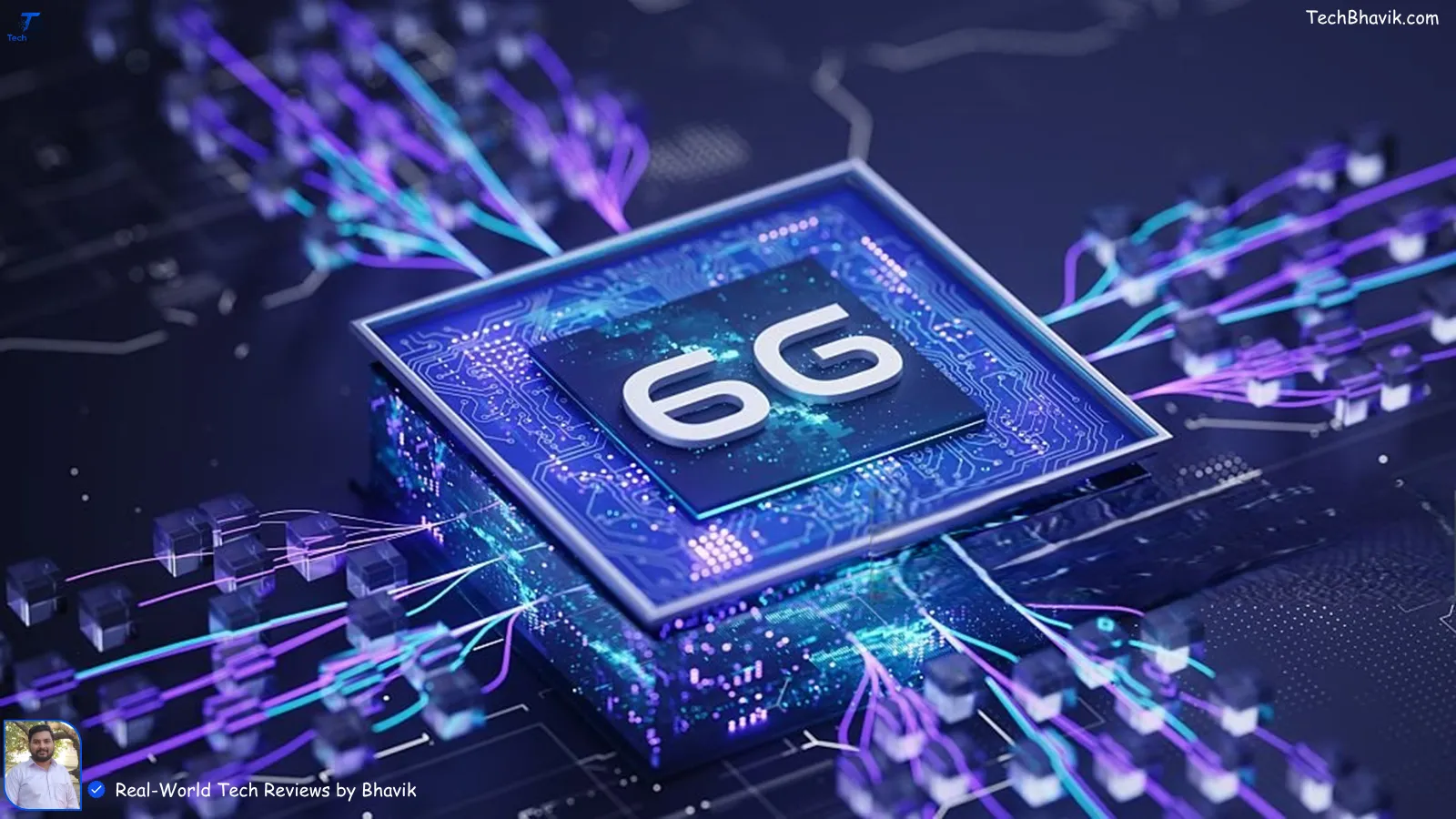
6G (the sixth-generation wireless network) is the planned successor to 5G cellular technology. Currently in the research and development phase, it is expected to hit commercial markets by the early 2030s.
Beyond simple speed upgrades, 6G is projected to fundamentally change how humans interact with the digital and physical worlds. The most notable differences and anticipated capabilities include:
- Extreme Speeds & Low Latency: It is expected to deliver data speeds up to 1 Tbps (nearly 100 times faster than 5G) and microsecond-level latency, potentially 1,000 times faster than 5G.
- Native Artificial Intelligence (AI): AI will be built directly into the network architecture to allow autonomous operations, proactive fault prediction, and dynamic energy optimization.
- Network Sensing: The mobile infrastructure will use radio waves to “perceive” its environment. This will allow networks to model environments, track road traffic, and map entire cities in 4D.
- Advanced Use Cases: The technology aims to power immersive experiences like real-time holographic communications, remote robotic surgery, and advanced IoT for smart cities.
- Global Coverage: 6G will combine traditional cell towers, long-range base stations, and low-Earth orbit (LEO) satellites to provide ubiquitous internet across the globe
But here’s the thing most people miss: 6G isn’t just about faster downloads. It’s a fundamentally different kind of network — one that’s being built with AI baked in from the ground up, not added as an afterthought.
While 5G gave us faster speeds and lower lag, 6G is designed to power things that feel closer to science fiction right now — holographic video calls, real-time telesurgery, fully autonomous vehicles reacting in microseconds, and smart cities that sense and respond to everything around them.
Related tech’s: Jio 5G vs Airtel 5G: The Shocking Indoor Coverage Reality No One Tells You
6G vs 5G: The Real Differences (Side-by-Side)
6G technology is poised to redefine connectivity by transitioning from gigahertz to the terahertz spectrum, promising speeds up to 1 Tbps and microsecond-level latency, far surpassing 5G capabilities.
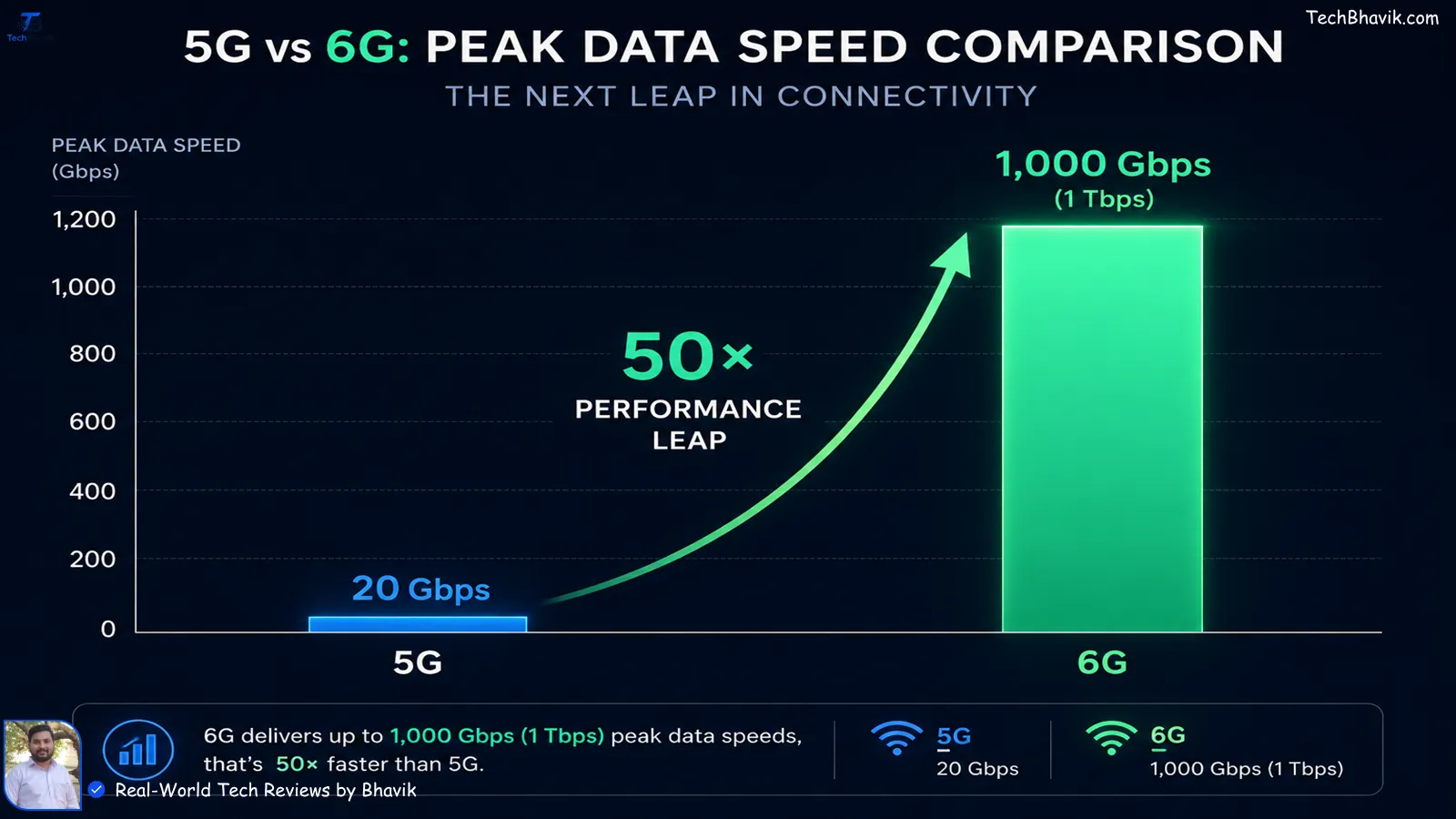
This next-generation network will feature natively integrated artificial intelligence, moving beyond 5G’s “dumb pipe” architecture to enable advanced applications like holographic communications and brain-computer interfaces by the early 2030s. Here’s where things get interesting. Let’s look at the numbers — and what they actually mean in the real world.
| Feature | 5G | 6G (Expected) |
|---|---|---|
| Peak Speed | Up to 20 Gbps | Up to 1 Tbps (1,000 Gbps) |
| Latency | ~5–10 ms | ~0.1–1 ms |
| Frequency Band | Sub-6 GHz & mmWave (up to 90 GHz) | Terahertz (95 GHz – 3 THz) |
| AI Integration | Add-on | Native (built-in) |
| Devices per km² | ~1 million | ~10 million+ |
| Energy Efficiency | Improved over 4G | Significantly higher than 5G |
| Commercial Launch | 2019–2020 | ~2030 |
Speed: Not Just Fast — Incomprehensibly Fast
5G at its best can hit around 20 Gbps under perfect lab conditions. In the real world, most users see speeds between 100–300 Mbps depending on their carrier and location.
6G is expected to reach 1 terabit per second (Tbps). To put that in perspective — that’s roughly 50 times faster than peak 5G.
Want a real-world example? A 3GB HD movie downloads in about 2 minutes on 5G. On 6G at 1 Tbps, that same movie would download in a fraction of a second. Not a few seconds — a fraction of one.
In September 2025, researchers in the U.S. and China successfully demonstrated a 6G chip capable of transferring data at 100 Gbps in a lab setting. That’s already 10,000 times faster than what most 5G users experience today.
Latency: The Difference That Actually Matters More
Speed grabs headlines. But latency — the delay between sending and receiving data — is actually more important for most next-gen use cases.
5G brought latency down to about 5–10 milliseconds. That’s fast. But 6G is targeting sub-1 millisecond, even down to 0.1 ms in controlled environments.
Why does this matter? Because things like remote surgery, autonomous vehicles, and industrial robotics need a network that responds instantly. A surgeon operating on a patient 3,000 miles away via a robotic arm cannot afford a 10ms delay. They need the feedback to feel immediate — just like being in the same room.
That’s the gap 6G is designed to close.
AI-Native Architecture: This Is the Big One
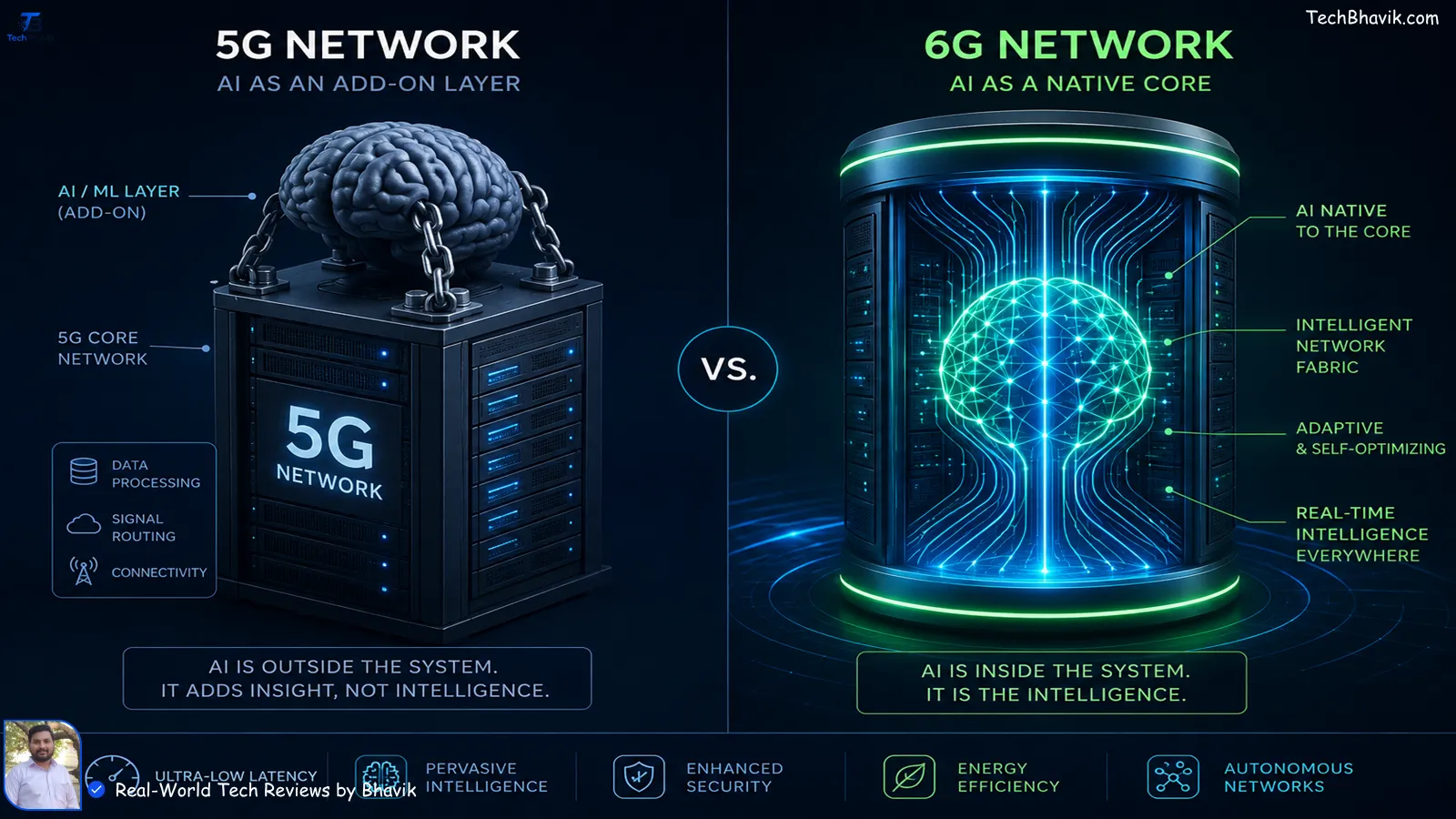
Here’s something most mainstream articles gloss over: 6G is being designed as an AI-native network.
With 5G, AI is essentially a layer bolted on top. Network management, spectrum allocation, signal optimization — all handled externally or as upgrades.
With 6G, AI is embedded directly into the core architecture. The network will self-manage, self-heal, and optimize itself in real time without human intervention. It will learn traffic patterns, predict congestion before it happens, and distribute resources intelligently across millions of connected devices simultaneously.
This isn’t just a performance upgrade. It’s a philosophical shift in how networks are designed.
What Can 6G Actually Enable?
Let’s step away from the numbers for a second and talk about what 6G makes possible in your day-to-day world.

1. Holographic Communication Forget video calls. 6G could power real-time, life-size holographic projections — meaning you could have a full 3D “presence” in a meeting room from anywhere in the world. This isn’t Star Wars fantasy anymore; it’s part of the formal 6G specification framework.
2. Remote Surgery Telesurgery at scale requires essentially zero lag and near-perfect reliability. 6G’s ultra-low latency and AI-driven network resilience could make remote surgical procedures routine — especially for patients in rural or underserved areas.
3. Fully Autonomous Vehicles Self-driving cars today rely heavily on onboard processing because current networks are too slow and unreliable to handle real-time external data at speed. 6G changes that equation entirely. Vehicles could communicate with each other and city infrastructure in real time, making split-second decisions with network-level intelligence backing them up.
4. True Smart Cities Imagine a city where traffic signals respond to real congestion instead of fixed timers, where environmental sensors detect pollution spikes and reroute pedestrian traffic, where emergency services coordinate seamlessly across an intelligent grid. 6G’s ability to connect 10x more devices per square kilometer than 5G makes this genuinely possible.
5. Extended Reality (XR) at Scale Augmented and virtual reality today requires significant local processing power and a solid Wi-Fi connection. 6G could offload that processing to the network itself — making lightweight XR glasses that feel as natural as regular eyewear a real prospect by the 2030s.
Who Is Building 6G Right Now?
6G development is a global race — and the competition is intense.
- China has made 6G a national priority, with it appearing in the country’s Five-Year Plan. Chinese research labs have already demonstrated record-breaking data rates in lab environments.
- South Korea and Japan have been among the most aggressive in government-backed 6G R&D, with NTT Docomo running early-stage trials.
- Europe has the Euro6G Testbed initiative, with large-scale field trials underway.
- United States — The FCC opened the 95 GHz–3,000 GHz spectrum band back in 2019, and the ATIS Next G Alliance (including AT&T, Verizon, T-Mobile, Microsoft, Samsung, and Ericsson) is coordinating North American 6G development.
- NVIDIA recently announced a $1 billion investment into Nokia specifically to develop AI-RAN solutions that work across 5G, 6G, and AI together — a major sign that the industry is preparing the infrastructure layer now.
The Official 6G Timeline: What’s Actually Happening
Let’s be honest about where things stand in 2026.
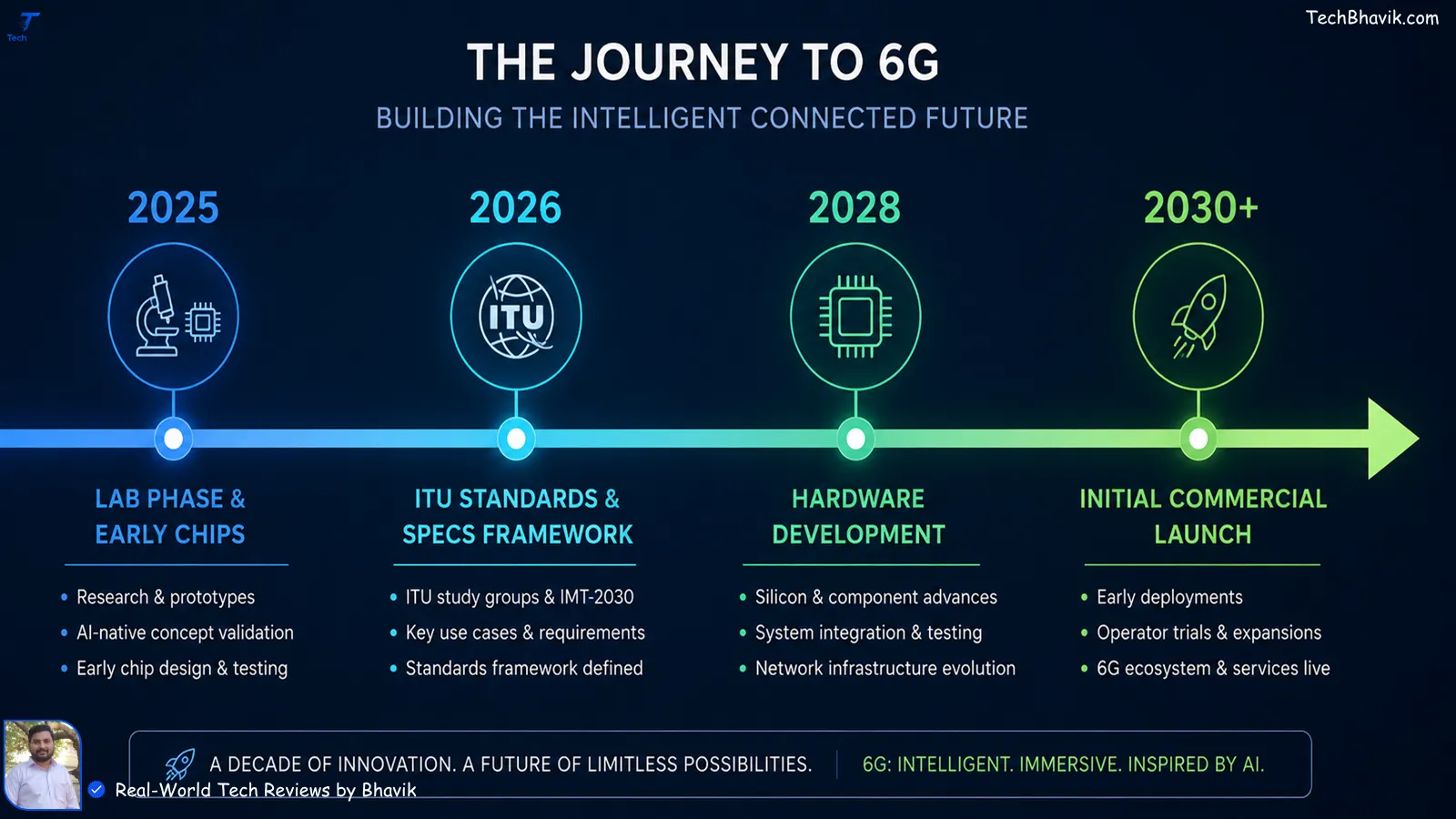
2020–2024: Pure research phase. Labs exploring terahertz frequencies, AI integration models, and architectural frameworks.
2025: 3GPP began work on Release 20, covering “5G Advanced” features and the earliest formal 6G research tracks. This is also when the first real 6G chip demonstrations happened in the lab.
2026 (Right Now): This is a pivotal year. The ITU and 3GPP are conducting the first phase of formal 6G standardization — essentially shifting the conversation from “what could 6G do?” to “what will 6G actually be built to do?” The technical performance requirements are being defined this year, and the first official 6G spec framework (IMT-2026) has been released.
2028: 3GPP Release 21 is expected to contain detailed 6G specifications — this is when vendors will start building hardware in earnest.
2030: First commercial 6G networks are anticipated — likely in South Korea, Japan, and parts of China initially, followed by major U.S. and European rollouts through the early 2030s.
One important reality check: unlike the hype cycle around 5G, the telecom industry is being deliberately cautious this time. Operators spent billions on 5G infrastructure only to find consumers weren’t willing to pay much of a premium for it. The expectation is that 6G rollout will be more measured — prioritising enterprise, industrial, and government use cases first, not just consumer phones.
Alt Text: A horizontal roadmap graphic illustrating the official 6G deployment timeline from early lab research in 2025, ITU standardization in 2026, hardware building in 2028, to commercial launch in 2030.
Will 6G Replace 5G?
Short answer: not immediately, and probably not the way 4G replaced 3G.
6G will initially roll out alongside 5G, not instead of it. The goal is coexistence and gradual migration — particularly because 5G is still expanding globally and most of the world hasn’t even experienced real mmWave 5G yet.
For most consumers, a 6G-capable smartphone is realistically a 2031–2033 purchase. For enterprises in manufacturing, healthcare, and logistics — the transition will likely start sooner, through private 6G networks in controlled environments.
What Should You Do Right Now?
If you’re a tech professional or business leader, here’s the honest advice:
Don’t wait on 6G to make current decisions. 5G infrastructure is maturing rapidly — as of 2026, 92% of U.S. urban areas have reliable mid-band 5G coverage. Use it.
Do pay attention to 6G enterprise pilots. If you’re in manufacturing, healthcare, logistics, or smart infrastructure, the first practical 6G deployments will likely target your industry. Watching pilot programs in Europe and Asia over the next 2–3 years will give you a genuine edge in planning.
Understand that 6G is an AI story as much as a connectivity story. The most important implication of 6G isn’t speed — it’s that the network itself becomes intelligent. Businesses that start building AI-integrated workflows now will be far better positioned when 6G networks arrive and those workflows can operate at full scale.
Jio 5G vs Airtel 5G — Which is Better
The Final Truths by Bhavik
6G isn’t vaporware. It’s a technology that’s in active, coordinated global development — with real milestones, real lab demonstrations, and real standardization happening right now in 2026.
But it’s also not around the corner. Commercial 6G is realistically a 2030 technology, with mainstream consumer adoption stretching into the mid-2030s.
What makes 6G genuinely exciting isn’t the speed number on a spec sheet. It’s the combination of terahertz connectivity, near-zero latency, and AI-native architecture that together create a platform for things that simply aren’t possible on today’s networks.
The future of connectivity isn’t just faster. It’s smarter.
Frequently Asked Questions
Q: When will 6G be available?
The first commercial 6G networks are expected around 2030, with mainstream consumer availability likely in the early-to-mid 2030s.
Q: How much faster is 6G than 5G?
6G is expected to reach peak speeds of 1 Tbps — roughly 50 times faster than peak 5G speeds and up to 10,000 times faster than what most 5G users experience in real-world conditions today.
Q: Do I need a new phone for 6G?
Yes. 6G will require new hardware — new modems, new antenna arrays capable of handling terahertz frequencies. Your current 5G phone will not be 6G-compatible.
Q: Is 6G available in India?
Not yet. India has published the Bharat 6G Vision document and is actively involved in global 6G research, but commercial deployment is expected in the 2030s alongside global rollout.
Q: Will 6G replace Wi-Fi?
Not fully, but 6G’s speeds and capacity could significantly blur the line between cellular and Wi-Fi connectivity, particularly in dense environments like offices, stadiums, and smart buildings.
Last updated: May 2026 | techbhavik.com