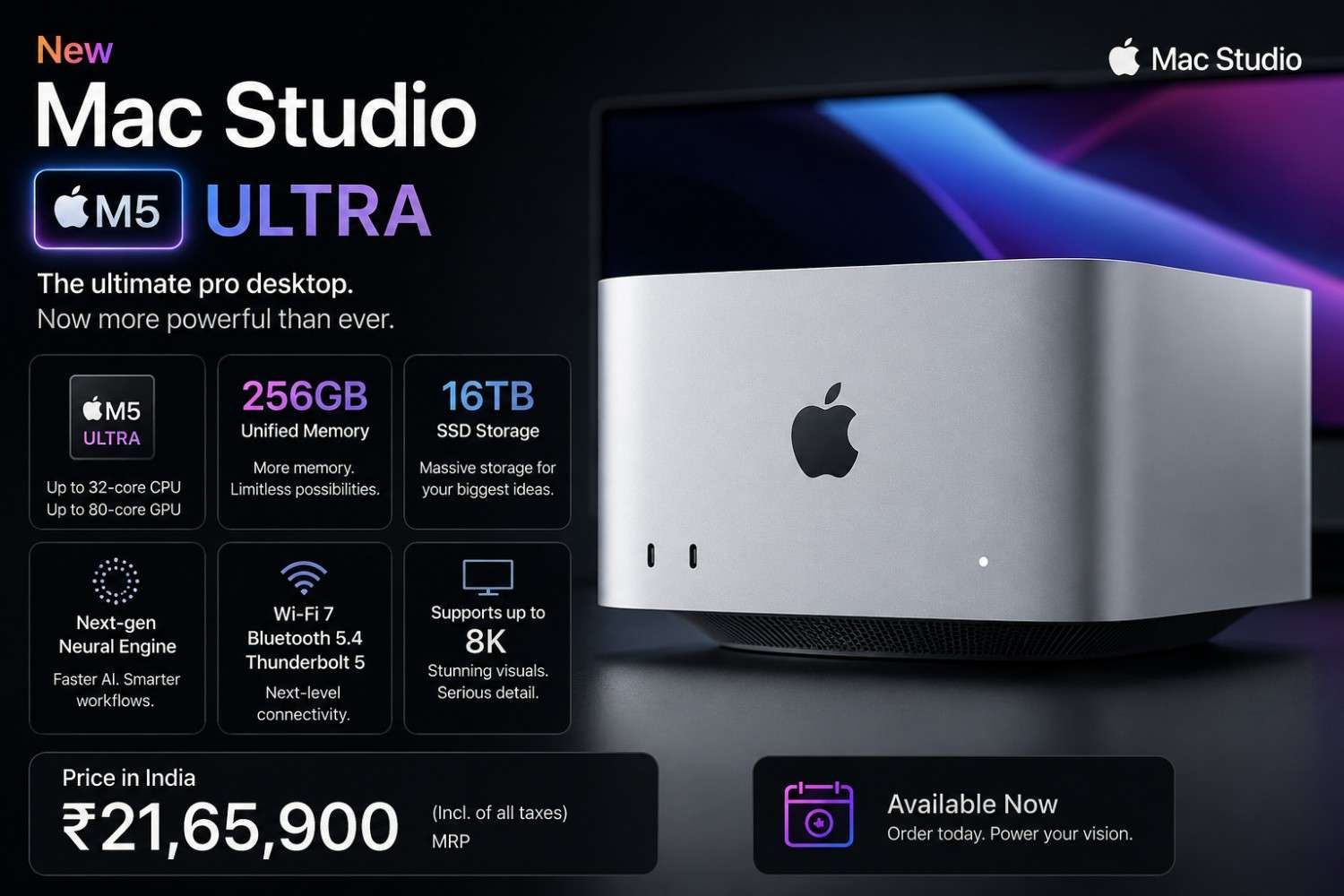

₹21.65 lakh for a Mac desktop sounds almost unbelievable.
But before you start wondering whether Apple has completely lost the plot, there is a bigger question: does a Mac Studio configuration with an M5 Ultra chip, 256GB unified memory and 16TB storage actually exist?
Right now, this needs a reality check.
Apple’s current official Mac Studio specifications list M4 Max and M3 Ultra, not an M5 Ultra. The current maximum listed configuration reaches 16TB SSD storage, but the official specification page does not list 256GB unified memory for the current Mac Studio.
So the ₹21,65,900 figure should not be presented as an officially confirmed Apple India price for an M5 Ultra Mac Studio.
That distinction matters if you are planning to publish this story for a technology audience.
What is actually available right now?
Apple’s current Mac Studio lineup is built around two chips:
- M4 Max
- M3 Ultra
The M3 Ultra configuration can reach a 32-core CPU, 80-core GPU and 32-core Neural Engine, with memory bandwidth of up to 819GB/s.
Storage can be configured up to 16TB SSD, which is the part of the ₹21.65-lakh claim that sounds plausible.
But there is a major problem with the 256GB RAM claim.
Apple’s current India specifications list up to 96GB unified memory for the Mac Studio configuration shown on its website.
In other words, putting together M5 Ultra + 256GB + 16TB + ₹21,65,900 currently goes beyond what Apple’s official Indian Mac Studio specification page confirms.
Why does 256GB unified memory matter so much?
This isn’t the same as simply installing 256GB of conventional desktop RAM.
Apple Silicon uses unified memory, meaning the CPU and GPU share a common high-bandwidth memory pool.
That architecture can be particularly useful for professional workloads where enormous datasets have to move between CPU and GPU resources.
Think about:
- Large AI models
- 3D rendering
- High-resolution video production
- Scientific simulations
- Machine-learning development
- Large software builds
- Virtual machines
- Massive photo libraries and databases
For a normal Chrome-and-Office workflow, however, 256GB would be extreme overkill.
I would compare it to buying a commercial generator to charge your phone.
It works, but the requirement is completely mismatched with the workload.
What makes the 16TB SSD configuration interesting?
The 16TB storage option is real on the current Mac Studio specification sheet. Apple lists 2TB, 4TB, 8TB and 16TB SSD configurations for the M3 Ultra model.
That’s useful for professionals working with enormous local datasets.
A video editor handling large ProRes projects, for example, can quickly consume several terabytes.
The same applies to photographers, 3D artists and developers working with large AI datasets.
The advantage of having that storage inside the machine is simple: you don’t have to constantly move projects between the internal SSD and external drives.
There is also a performance consideration. Internal storage can provide a much cleaner workflow than juggling several external drives, although serious production users will still maintain backups.
Why could an Ultra-class Mac become incredibly expensive?
Apple’s Mac Studio is a configurable professional desktop.
The entry-level price doesn’t tell the whole story.
Apple’s current India store lists Mac Studio from ₹2,79,900, while higher-end configurations can become dramatically more expensive as memory, chip and storage options increase.
The company’s 2025 launch announcement originally listed Mac Studio starting at ₹2,14,900, with additional configure-to-order options available.
That’s how workstation pricing works.
The base machine might look reasonable, but adding high-end silicon, huge memory capacity and maximum storage can push the final bill into a completely different category.
Who would actually need a machine like this?
This is where the discussion becomes more interesting.
If Apple eventually offers a Mac Studio with something approaching 256GB unified memory, I would expect the target customer to be a very specific professional.

AI developers
Large language models increasingly require substantial memory.
For local inference, model development and experimentation, more memory can allow developers to work with larger models without constantly relying on cloud infrastructure.
That’s potentially one of the strongest reasons for an ultra-high-memory Mac.
Professional video editors
Editors working with multiple high-resolution streams can benefit from large memory pools.
Apple’s media engines are also designed specifically for professional video workflows, including hardware acceleration for formats such as H.264, HEVC and ProRes.
For someone editing professionally every day, time saved during rendering and media processing can have a real financial value.
3D artists and designers
Large scenes, textures and complex simulations can consume huge amounts of memory.
A high-memory workstation can reduce the need to constantly simplify projects or move data between applications.
Developers and researchers
A developer running multiple containers, virtual machines, databases and local AI models simultaneously could actually make use of an unusually large memory pool.
For most programmers, though, 256GB would still be excessive.
A Real-World Example: Where Would I Notice the Difference?
Imagine I am working on a large AI project.
I have several local models, a database, multiple Docker containers, an IDE, a browser with dozens of tabs and several development tools running simultaneously.
With a normal 16GB or 32GB machine, memory pressure can quickly become the bottleneck.
With a workstation offering extremely large unified memory, I could keep much more of that workload resident in memory.
That’s where expensive workstation hardware starts making sense.
But if I’m writing WordPress articles, editing thumbnails and browsing the web, I wouldn’t even come close to exploiting that hardware.
For a site like TechBhavik, I would rather spend the difference on storage, backup infrastructure, networking equipment and other tools that improve the actual publishing workflow.
Does ₹21,65,900 Make Sense?
Here’s my biggest concern with the headline.
₹21,65,900 is a huge number, but without an official Apple configuration page confirming it, we shouldn’t treat it as established fact.
Apple’s current India Mac Studio page does not show an M5 Ultra configuration. It currently identifies the Mac Studio as being powered by M4 Max and M3 Ultra.
Apple’s current technical specifications also don’t show a 256GB unified-memory option.
So if you’re seeing the ₹21.65-lakh figure circulating online, treat it as a rumor, speculative configuration, third-party listing or possible pricing calculation until Apple officially confirms it.
That’s a much safer approach than publishing a speculative price as fact.
What Could an M5 Ultra Mac Studio Change?
If Apple eventually introduces an M5 Ultra Mac Studio, the interesting question won’t simply be benchmark scores.
It will be how much work can be completed locally.
Apple’s direction with Apple Silicon has increasingly focused on CPU, GPU, Neural Engine, memory bandwidth and media acceleration working together.
An Ultra-class chip could therefore be particularly interesting for:
- Local AI inference
- Machine-learning development
- Professional rendering
- 8K video workflows
- Large software projects
- Scientific workloads
- High-end content creation
The combination of powerful CPU and GPU resources with large unified memory could make a future Mac Studio particularly attractive to professionals who want a compact workstation.
The Big Catch: Most People Don’t Need It
This is the part that often gets lost in specification-heavy tech stories.
More RAM doesn’t automatically make every application dramatically faster.
If an application only needs 16GB, giving it 256GB doesn’t make it magically use all 256GB.
The same applies to CPU and GPU performance.
If your workload is primarily:
- Chrome
- Microsoft Office
- Photoshop
- WordPress
- YouTube
- Light video editing
- Casual programming
then spending ₹20 lakh-plus on a desktop would make very little financial sense.
A well-configured Mac mini, Mac Studio or MacBook Pro could already handle those tasks extremely well.
What About the Current M3 Ultra Mac Studio?
The current M3 Ultra is already a serious workstation.
Apple lists it with up to:
- 32-core CPU
- 80-core GPU
- 32-core Neural Engine
- 819GB/s memory bandwidth
- 16TB SSD
- Hardware-accelerated ray tracing
- Multiple dedicated media engines
Those specifications make it a genuine professional workstation rather than simply a premium desktop computer.
And that’s why an eventual successor would have a difficult job.
Apple wouldn’t just need to make it faster.
It would need to provide meaningful improvements for professional workloads.
My Verdict: Don’t Buy the Rumor
If you are considering a Mac Studio because of the ₹21,65,900 M5 Ultra, 256GB RAM and 16TB claim, my recommendation is simple:
Wait for official confirmation.
As of the latest Apple India specifications available, the Mac Studio uses M4 Max or M3 Ultra, supports up to 16TB storage, and the listed unified-memory configurations do not include 256GB.
The ₹21.65-lakh configuration therefore shouldn’t currently be described as an officially launched Apple product.
If Apple eventually launches an M5 Ultra with 256GB unified memory, then we can properly evaluate its performance, pricing and professional value.
Until then, the current M3 Ultra Mac Studio is the confirmed Ultra-class Mac Studio to look at.
Final Recommendation
For AI researchers and professional creators: Watch the next Ultra-class Mac Studio closely.
For developers: Buy based on your actual memory and compute requirements, not the maximum specification.
For video professionals: The M3 Ultra and 16TB configuration already provide an extremely capable platform.
For everyday users: Save your money. You absolutely do not need a ₹21.65-lakh desktop.
For buyers seeing the ₹21,65,900 claim online: Verify the configuration on Apple’s official store before paying anyone.
Frequently Asked Questions
Is Apple launching an M5 Ultra Mac Studio?
Apple’s currently published Mac Studio specifications list M4 Max and M3 Ultra. An M5 Ultra Mac Studio is not currently confirmed on Apple’s official India Mac Studio pages.
Does Mac Studio support 256GB RAM?
The current Apple India specifications do not list 256GB unified memory. The current Mac Studio configurations shown by Apple go up to 96GB unified memory.
Can Mac Studio have 16TB storage?
Yes. Apple’s current M3 Ultra Mac Studio specification includes a configurable 16TB SSD option.
How much does the Mac Studio cost in India?
Apple’s India store currently lists Mac Studio from ₹2,79,900, while higher configurations cost substantially more.
Is a ₹21,65,900 Mac Studio worth buying?
Only for an extremely demanding professional workload—and only if Apple officially confirms the configuration. For ordinary productivity, content creation and programming, such a machine would be massive overkill.
Summary
The headline “Apple New Mac Studio with M5 Ultra, 256GB RAM and 16TB is costing ₹21,65,900” makes for an eye-catching story, but the current official Apple specifications don’t support presenting that configuration as a confirmed product.
Apple currently lists the Mac Studio with M4 Max and M3 Ultra, while 16TB storage is available on the M3 Ultra configuration. The claimed 256GB memory and M5 Ultra combination remain unconfirmed.
For now, the most sensible move is to separate confirmed Apple specifications from rumors and speculative pricing.
That’s especially important with a machine costing more than many cars.