Honor Robot Phone with 200MP Gimbal Camera: Features, Price & India Launch Details
A phone camera that moves by itself.
That is the easiest way to understand the new Honor Robot Phone, which has officially launched in China today, August 12, 2026.
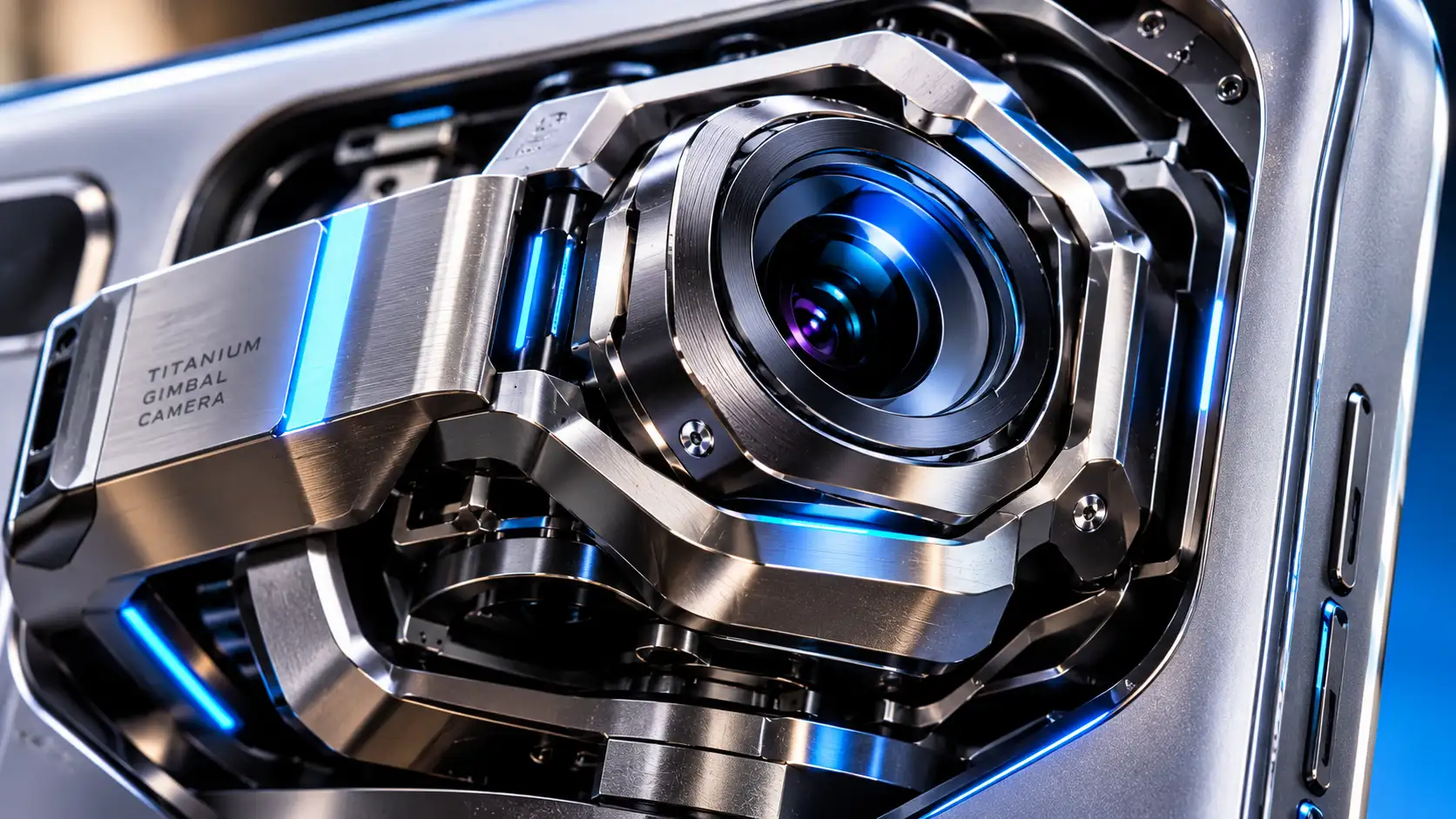
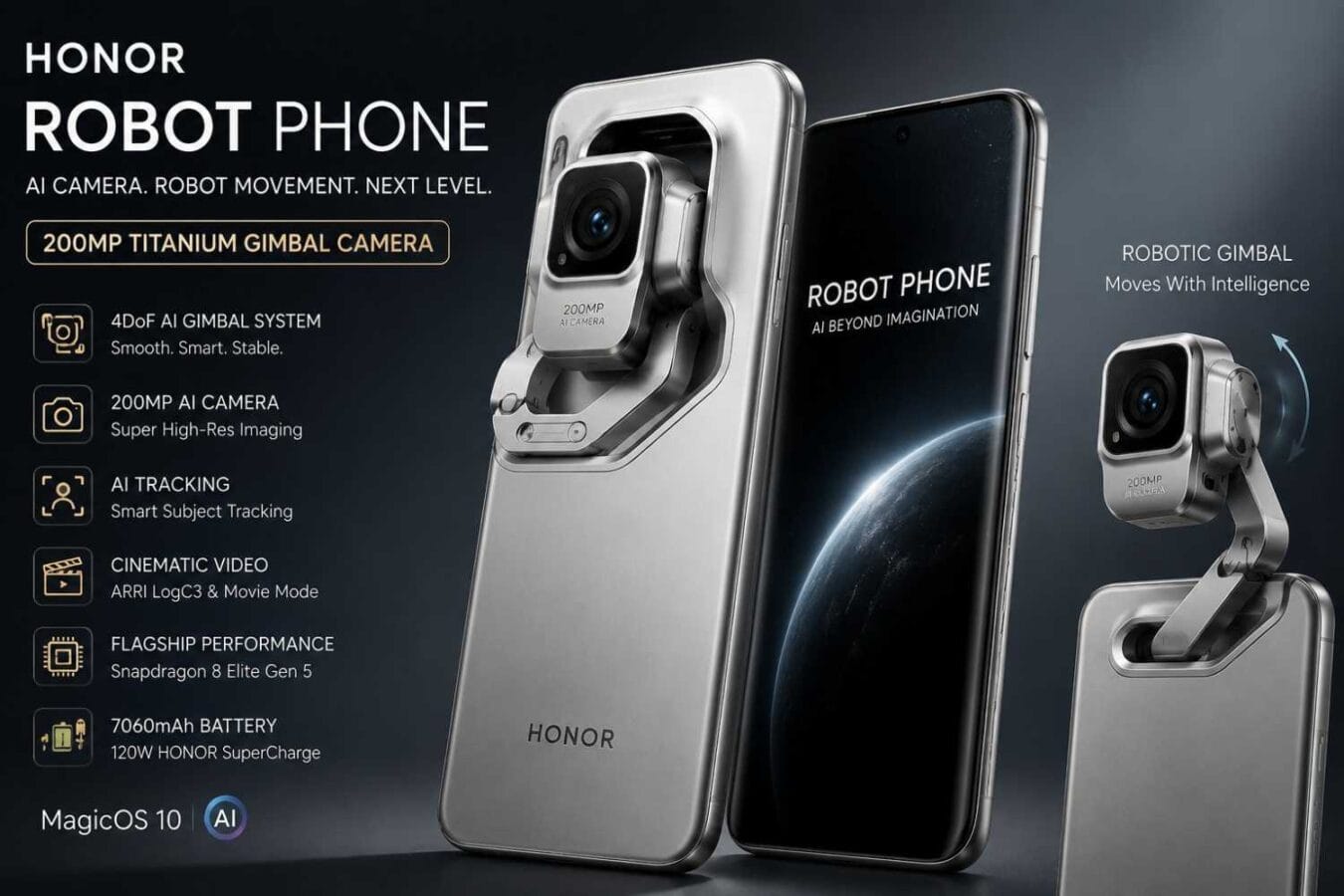
Instead of adding another oversized camera island to the back, Honor built a miniature mechanical gimbal into the phone itself. The camera can physically move, track subjects, and create controlled movements while recording video.
Honor has previously described the Robot Phone as its first major attempt to bring embodied AI—AI that can interact with the physical world—into a smartphone. The company first showed the device at MWC 2026 before opening reservations in China.
And yes, the headline feature is exactly what it sounds like: a 200MP camera mounted on a robotic gimbal system.
Quick Answer
The Honor Robot Phone is one of the most unique smartphones launched in 2026. Its biggest feature is a 200MP camera mounted on a mechanical titanium gimbal that can physically move, track subjects, and stabilise videos. The phone is aimed at content creators, vloggers, and mobile filmmakers rather than ordinary smartphone users.
While the technology is impressive, the high price, extra weight, and limited availability make it a niche product rather than a mainstream flagship.

Key Highlights
- 200MP camera with mechanical titanium gimbal
- AI-powered subject tracking
- ARRI cinematic video technology
- Snapdragon 8 Elite Gen 5 processor
- 7060mAh silicon-carbon battery
- 120W fast charging
- Up to 16GB RAM and 1TB storage
- Designed primarily for content creators
What Makes the Honor Robot Phone Different?
Most smartphones use software stabilisation to reduce camera shake. The Honor Robot Phone takes a completely different approach.
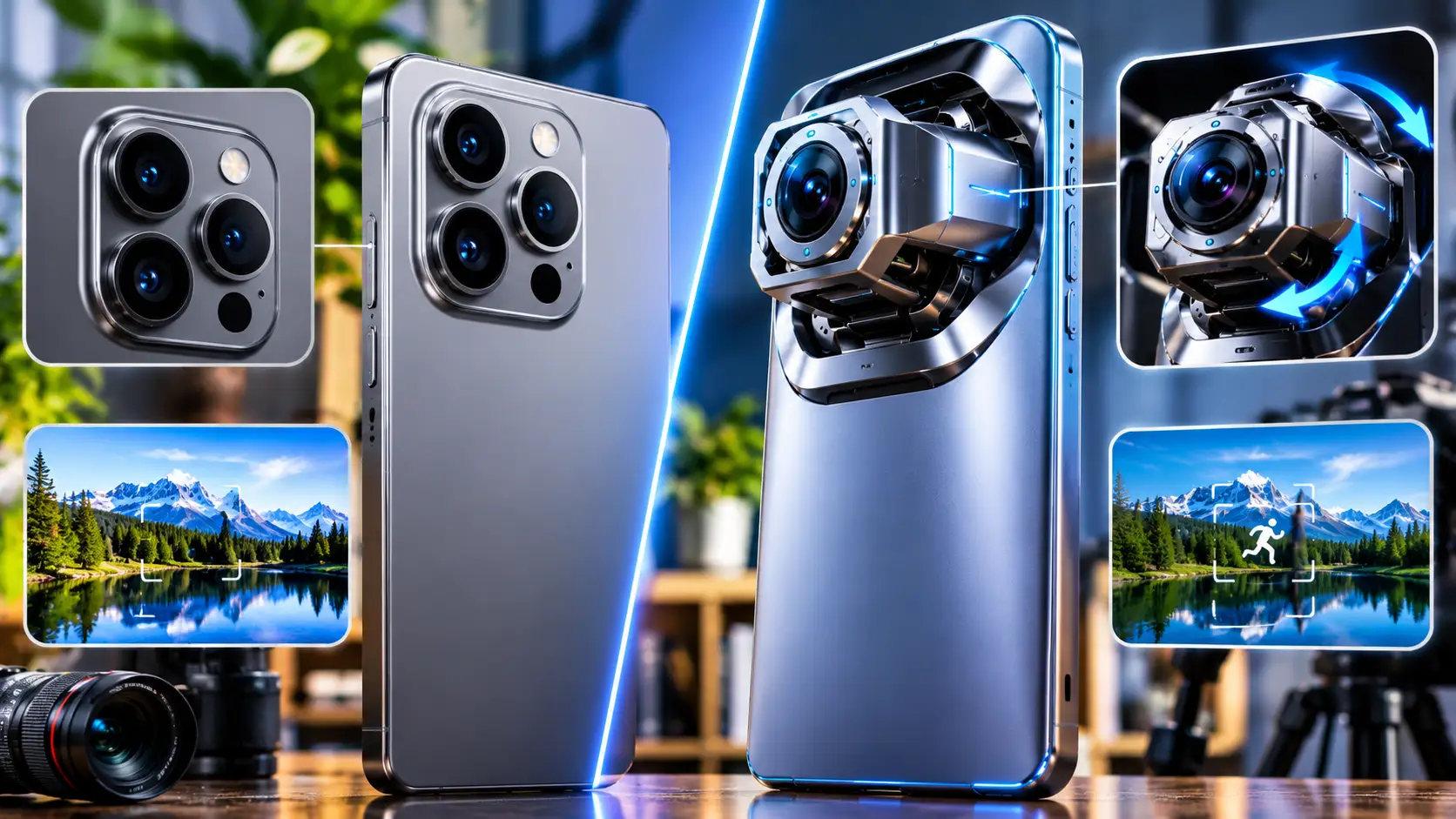
Instead of keeping the camera fixed in one position, Honor has built a tiny robotic gimbal directly into the phone. This allows the camera to physically move and follow subjects while recording videos.
Think of it as combining a premium flagship smartphone and a compact camera gimbal into a single device.
The camera can actually move
When the gimbal is activated, the camera mechanism rises from its stored position and can move independently of the phone.
Honor says the system supports features such as:
- AI subject tracking
- Super Steady video
- AI SpinShot
- Creative camera movements
- 360-degree subject tracking
- Automated panning
- Hands-free shooting
- Improved selfie positioning
Honor demonstrated these capabilities earlier this year, including intelligent 90-degree and 180-degree rotational movements for cinematic transitions.
That makes the Robot Phone feel less like a conventional camera phone and more like a smartphone combined with a miniature motorized camera.
Related: Vivo X300 Ultra 16 GB 512 GB Camera Phone
The 200MP camera is the real star
The headline 200MP sensor isn’t there simply to win a megapixel-number competition.
The main camera reportedly uses a large 1/1.28-inch-type sensor with an f/1.6 aperture, while the phone also has a 200MP periscope telephoto and 50MP ultrawide camera.
This combination is particularly interesting for people who shoot video and photography directly from their phone.
A larger sensor can collect more light, while the physical stabilization system can help keep the sensor steady during exposure.
That combination could be useful for:
- Night photography
- Moving subjects
- Walking videos
- Vlogging
- Self-recording
- Sports clips
- Travel videos
- Livestreaming
The important distinction is that 200MP alone doesn’t guarantee better image quality. Sensor size, lens quality, stabilization, processing, and dynamic range all contribute to the final result.
That’s why the gimbal is arguably more interesting than the megapixel count.
Who Should Buy the Honor Robot Phone?
- YouTube creators
- Vloggers
- Travel content creators
- Mobile filmmakers
- Livestreamers
- Users who frequently shoot videos without assistance
Who Should Avoid the Honor Robot Phone?
- Casual smartphone users
- Budget-conscious buyers
- Users who rarely record videos
- People looking for a light and compact phone
- Buyers concerned about moving mechanical parts
Why the titanium gimbal matters
Miniaturizing a mechanical gimbal into a smartphone isn’t an easy engineering problem.
A normal smartphone already has to fit a battery, processor, cooling system, cameras, antennas, and other components into a thin chassis.
Now add motors, moving mechanical parts, and a camera arm.
Honor says its 4DoF gimbal uses a titanium-alloy structure and miniature motors. The company has also claimed the motor system is around 70% smaller than mainstream solutions.
That’s a significant engineering challenge because the mechanism has to remain accurate while surviving something that conventional gimbals don’t have to deal with every day: being carried around as your primary smartphone.
Related: World’s Most Expensive iPhone: Falcon Supernova iPhone 6 Pink Diamond Edition Explained
ARRI partnership could make this more than a camera gimmick
This is where the Robot Phone becomes particularly interesting for serious creators.
Honor has partnered with ARRI, the German cinema-camera company known for professional filmmaking equipment and color science.
Honor says the partnership brings ARRI imaging technology to the Robot Phone, including professional-oriented color and video workflows.
The phone supports ARRI LogC3 and ARRI-related cinematic looks, giving creators more flexibility when grading footage.
For someone who only uploads quick Instagram Reels, this may not matter much.
But for filmmakers, YouTubers, and professional creators who edit footage in software such as DaVinci Resolve or Adobe Premiere Pro, shooting with a log profile can provide considerably more flexibility during post-production.
That’s the kind of feature I would pay more attention to than simply seeing “200MP” printed on a specification sheet.
How would this help a normal content creator?
Imagine you’re recording yourself explaining a new smartphone.
Normally, you need:
- A tripod.
- A smartphone or camera.
- A gimbal or motorized tripod head.
- A remote control.
- Someone to operate the camera—or several takes.
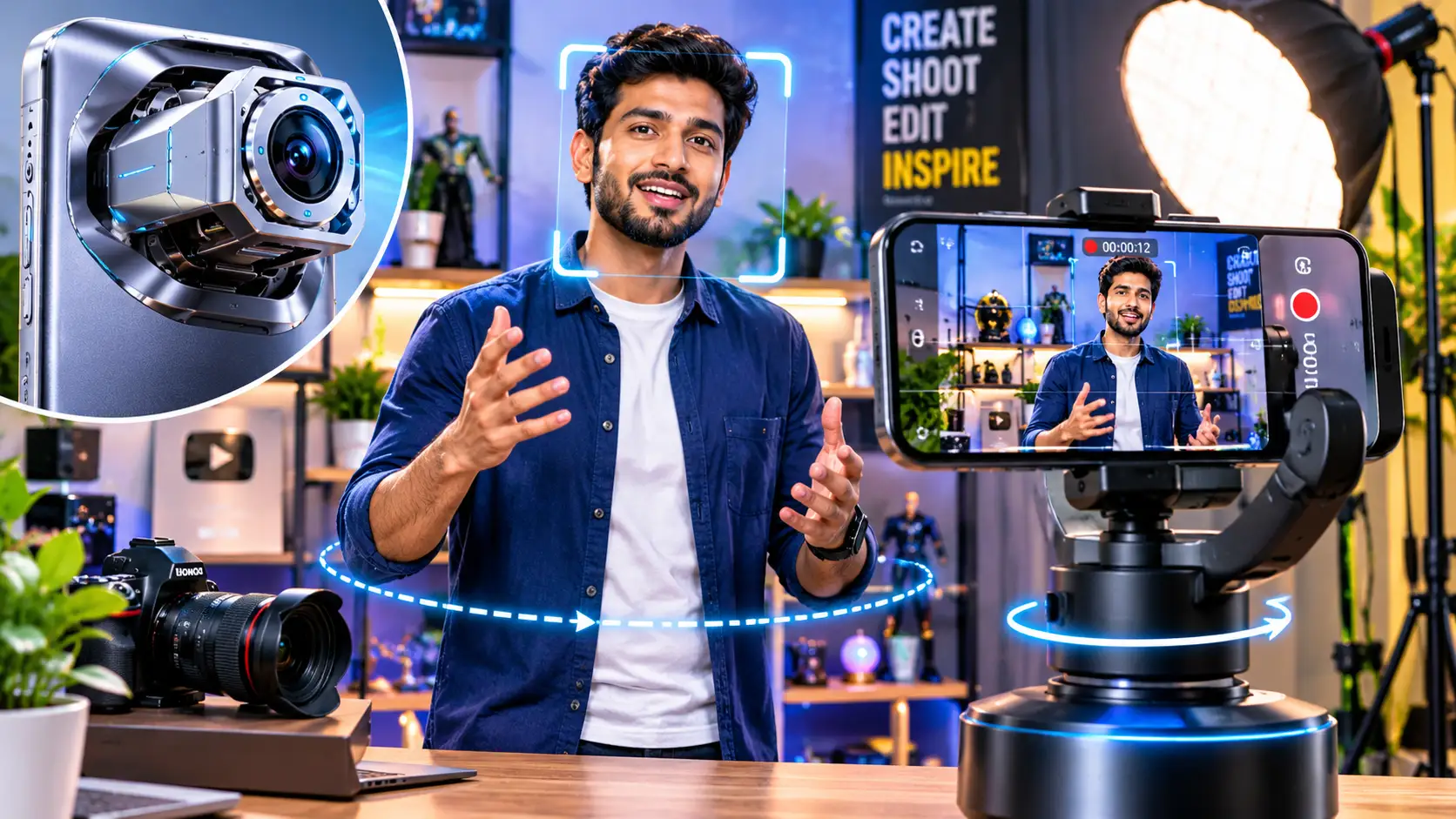
With the Robot Phone, the camera can track the subject itself.
You can walk across a room while the camera follows you.
You can also use the phone’s main camera for selfies rather than relying entirely on a small front-facing sensor.
That could be genuinely useful for solo creators.
A simple real-world scenario
Imagine I’m recording a smartphone review alone.
Put the Robot Phone on a table, start video recording, and walk into the frame.
Instead of manually adjusting the tripod every time I move, the camera can track me.
If I move sideways, the gimbal can follow.
If I want a smooth transition, I can use one of the automated movement modes.
That doesn’t replace a professional camera operator.
But for a creator working alone, it can remove several pieces of equipment from the setup.

It isn’t just about cameras
Honor is also positioning the Robot Phone as an AI device with physical movement, rather than simply a smartphone with a motorized camera.
The company’s Agentic OS concept is designed around AI that can perceive information, reason about tasks, and interact with services or devices.
Honor has demonstrated examples such as ordering food, booking transportation, and coordinating multiple tasks through its AI system.
The camera itself can also react to commands and perform movements.
That’s why Honor calls it a “Robot Phone.”
Personally, I think the camera hardware is much more compelling than the novelty of making the phone “dance.” The dancing demonstrations are fun, but subject tracking and automated camera movement have a much clearer practical use.
What are the main specifications?
The final retail hardware puts the Robot Phone firmly in flagship territory.
| Feature | Honor Robot Phone |
|---|---|
| Main camera | 200MP |
| Main camera stabilization | Mechanical gimbal |
| Gimbal | 4DoF titanium-alloy system |
| Telephoto | 200MP periscope |
| Ultrawide | 50MP |
| Processor | Snapdragon 8 Elite Gen 5 |
| Display | 6.3-inch-class, 1.5K |
| RAM | Up to 16GB |
| Storage | Up to 1TB |
| Battery | 7,060mAh silicon-carbon |
| Charging | 120W |
| Video | AI tracking, Super Steady, creative gimbal modes |
| Professional video | ARRI LogC3 and cinematic profiles |
| Launch market | China |

The big trade-off: size and durability
This is the part that shouldn’t be ignored.
A moving camera mechanism is fascinating—but moving parts create additional engineering and durability concerns.
The Robot Phone is around 248g and 9.6mm thick before accounting for the prominent camera section.
That’s not exactly a lightweight smartphone.
There is also a durability compromise.
The phone carries an IP54 rating when the camera is stowed, according to hands-on reporting, and that protection does not apply in the same way when the gimbal is extended.
That means I wouldn’t treat this like a conventional rugged flagship.
Dust, water, accidental drops, and mechanical stress are all more concerning when your camera physically moves.
What about the price?
The Robot Phone starts at ¥9,999 in China, according to launch-day reporting. That’s roughly $1,480 before considering taxes, import costs, and currency conversion for other markets.
That puts it firmly in premium territory.
For comparison, a serious creator could buy a conventional flagship smartphone and a separate compact gimbal camera.
So the Robot Phone’s value proposition isn’t simply “more camera for the money.”
It’s about having the entire system integrated into one device.
Is it coming to India?
For Indian buyers, this is probably the biggest question.
As of the China launch, the Robot Phone is being sold in China, and Honor has indicated that it does not currently plan a wider release.
So if you’re waiting for an official Indian launch, I would not assume an India release yet.
And I would definitely avoid treating unofficial China imports as equivalent to an official Indian model.
Warranty coverage, network compatibility, software services, regional features, and repair availability can all become issues.
Best Alternatives to the Honor Robot Phone
Vivo X300 Ultra
Better suited for photography enthusiasts who want flagship camera hardware without a mechanical gimbal.
iPhone 18 Pro Max
A strong option for creators who prefer Apple’s ecosystem and advanced video recording features.
Google Pixel 11
Ideal for users who prioritise AI features and computational photography.
Samsung Galaxy S27 Ultra
Offers a balanced flagship experience with powerful zoom and productivity features.
Final Verdict: Is the Robot Phone actually worth it?
The Honor Robot Phone is one of the most innovative smartphones launched in 2026. Its robotic camera system introduces a new way of recording video directly from a smartphone and offers capabilities that traditional camera systems cannot easily replicate.
For content creators, vloggers, and mobile filmmakers, the built-in gimbal, AI tracking, and ARRI-inspired video tools provide genuine practical advantages.
However, the higher price, larger size, and mechanical complexity mean it is not a device designed for everyone. Most everyday smartphone users will likely find greater value in traditional flagship models.
If your goal is creating better video content directly from a smartphone, the Honor Robot Phone is one of the most interesting devices currently available.
TechBhavik Analysis: The most interesting aspect of the Honor Robot Phone is not its 200MP resolution, but the combination of a mechanical gimbal, AI subject tracking, and creator-focused video tools. For content creators, these features provide practical advantages that go beyond traditional smartphone photography.
TechBhavik Rating: 4.5/5
FAQs
What is the Honor Robot Phone?
The Honor Robot Phone is a flagship Android smartphone with a mechanically moving camera system. Its main 200MP camera is mounted on a compact 4DoF gimbal that can physically move for stabilization, tracking, and creative camera movements.
Does the Honor Robot Phone really have a 200MP gimbal camera?
Yes. The main camera uses a 200MP sensor integrated with the mechanical gimbal system. Honor has positioned the combination as a major part of the phone’s imaging system.
What is special about the Honor Robot Phone camera?
Unlike a conventional fixed smartphone camera, the Robot Phone’s gimbal can physically move. It supports AI subject tracking, Super Steady video, SpinShot-style movements, and other automated camera controls.
Does the Honor Robot Phone support ARRI technology?
Yes. Honor has partnered with ARRI to bring professional imaging technology to its mobile devices, with the Robot Phone supporting ARRI-related cinematic profiles and LogC3 recording.
How much does the Honor Robot Phone cost?
The phone starts at ¥9,999 in China, according to launch-day reporting.
Will the Honor Robot Phone launch in India?
There is currently no confirmed official Indian launch. The initial commercial release is focused on China, so Indian buyers should wait for an official announcement rather than relying on unofficial import listings.
Quick Summary
Honor Robot Phone = smartphone + 200MP camera + mechanical gimbal + AI tracking + ARRI video technology.
Its biggest strengths are the moving camera, creator-focused features, and unusual hardware design.
Its biggest weaknesses are the high price, added bulk, and concerns around the durability of a mechanical camera system.
For creators, it’s genuinely interesting.
For ordinary users, it’s probably overkill.
Editorial Note:
This article is based on official Honor announcements, product launch information, published specifications, and independent analysis prepared by TechBhavik. The objective is to explain the technology behind the Honor Robot Phone in simple language and help readers understand its practical advantages, limitations, and real-world use cases.
Official Sources:
- Honor Official Global Announcement
- Honor Official China Launch Information
- Honor × ARRI Collaboration Announcement
- Honor AI and Robot Phone Technology Information
Related Articles:
- Vivo X300 Ultra Camera Review
- Google Pixel 11 Full Specifications
- iPhone 18 Pro Max Review
- iPhone 18 Pro vs iPhone 17 Pro

Bhavik Munjpara is the Founder & Editor of TechBhavik.com, an independent technology website based in Gujarat, India. He writes about smartphones, laptops, computer hardware, software, AI tools, and practical technology guides. His goal is to explain complex technology in simple, accurate, and useful language. Content is researched using official information and reliable sources, with hands-on experience mentioned only when personally available.