
Honor Robot Phone Launches in China With a 200MP Titanium Gimbal Camera
A phone camera that moves by itself.
That is the easiest way to understand the new Honor Robot Phone, which has officially launched in China today, August 12, 2026.
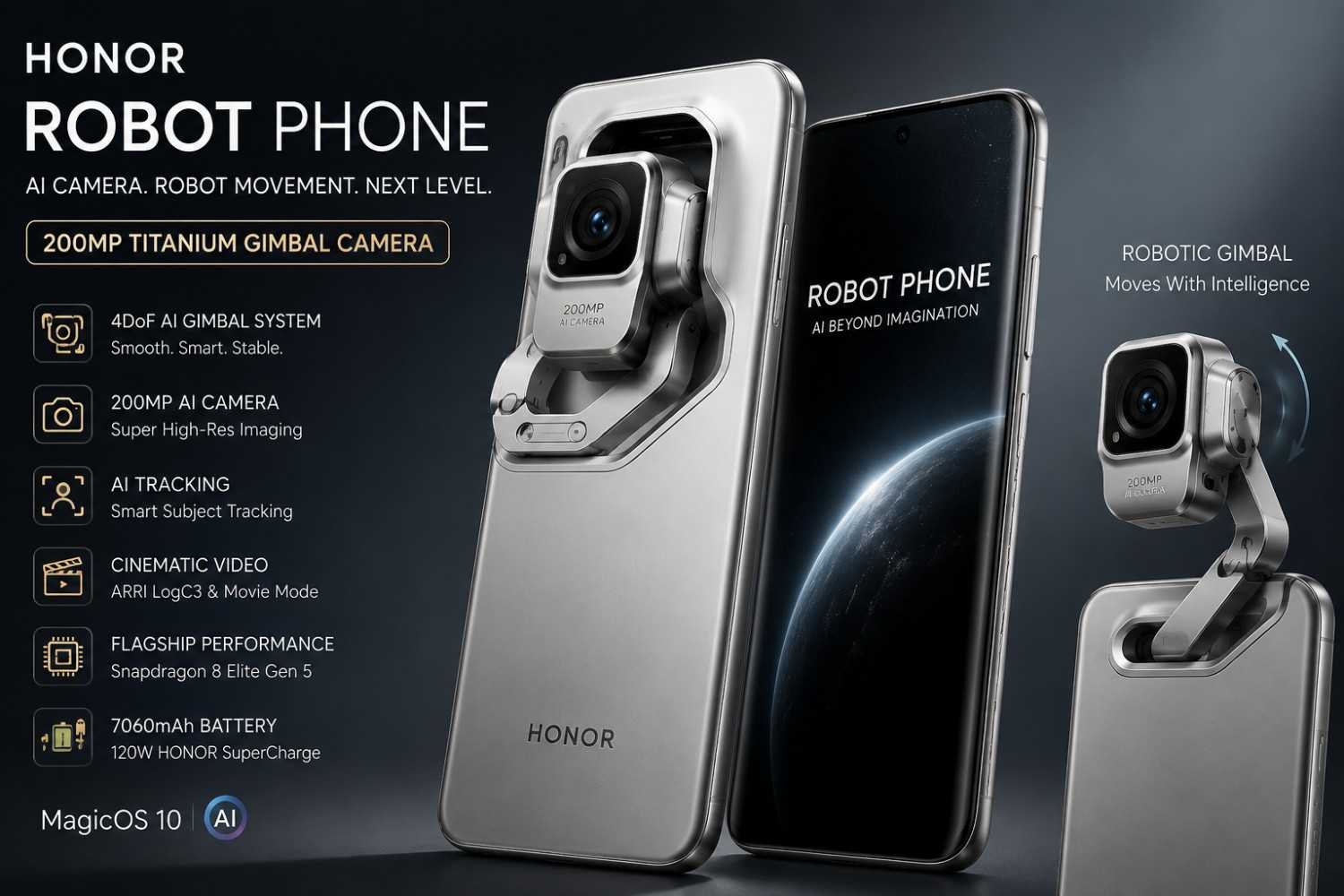
Instead of putting another oversized camera island on the back, Honor has built a miniature mechanical gimbal into the phone itself. The camera can physically move, track subjects and create controlled movements while recording video.
Honor has previously described the Robot Phone as its first major attempt to bring embodied AI—AI that can interact with the physical world—into a smartphone. The company first showed the device at MWC 2026 before opening reservations in China. (Honor)
And yes, the headline feature is exactly what it sounds like: a 200MP camera mounted on a robotic gimbal system.
What makes the Honor Robot Phone different?
Most smartphone cameras are completely fixed.
Software can electronically stabilize the image, but the lens and sensor themselves don’t physically follow you.
The Robot Phone takes a different approach.
Its main camera is connected to a compact four-degree-of-freedom (4DoF) mechanical gimbal. Honor says the system uses extremely small motors and a titanium-alloy structure to fit the mechanism inside a smartphone. (TechNode)
The result is a camera that can physically change its orientation rather than relying only on software stabilization.
That matters because mechanical movement can help with things software alone struggles to replicate—particularly controlled panning, subject tracking and keeping a subject within the frame.
The camera can actually move
When the gimbal is activated, the camera mechanism rises from its stored position and can move independently of the phone.
Honor says the system supports features such as:
- AI subject tracking
- Super Steady video
- AI SpinShot
- Creative camera movements
- 360-degree subject tracking
- Automated panning
- Hands-free shooting
- Improved selfie positioning
Honor demonstrated these capabilities earlier this year, including intelligent 90-degree and 180-degree rotational movements for cinematic transitions. (Honor)
That makes the Robot Phone feel less like a conventional camera phone and more like a smartphone combined with a miniature motorized camera.
The 200MP camera is the real star
The headline 200MP sensor isn’t there simply to win a megapixel-number competition.
The main camera reportedly uses a large 1/1.28-inch-type sensor with an f/1.6 aperture, while the phone also has a 200MP periscope telephoto and 50MP ultrawide camera. (Digital Camera World)
This combination is particularly interesting for people who shoot video and photography directly from their phone.
A larger sensor can collect more light, while the physical stabilization system can help keep the sensor steady during exposure.
That combination could be useful for:
- Night photography
- Moving subjects
- Walking videos
- Vlogging
- Self-recording
- Sports clips
- Travel videos
- Livestreaming
The important distinction is that 200MP alone doesn’t guarantee better image quality. Sensor size, lens quality, stabilization, processing and dynamic range all contribute to the final result.
That’s why the gimbal is arguably more interesting than the megapixel count.
Why the titanium gimbal matters
Miniaturizing a mechanical gimbal into a smartphone isn’t an easy engineering problem.
A normal smartphone already has to fit a battery, processor, cooling system, cameras, antennas and other components into a thin chassis.
Now add motors, moving mechanical parts and a camera arm.
Honor says its 4DoF gimbal uses a titanium-alloy structure and miniature motors. The company has also claimed the motor system is around 70% smaller than mainstream solutions. (TechNode)
That’s a significant engineering challenge because the mechanism has to remain accurate while surviving something that conventional gimbals don’t have to deal with every day: being carried around as your primary smartphone.
ARRI partnership could make this more than a camera gimmick
This is where the Robot Phone becomes particularly interesting for serious creators.
Honor has partnered with ARRI, the German cinema-camera company known for professional filmmaking equipment and color science.
Honor says the partnership brings ARRI imaging technology to the Robot Phone, including professional-oriented color and video workflows. (Honor)
The phone supports ARRI LogC3 and ARRI-related cinematic looks, giving creators more flexibility when grading footage.
For someone who only uploads quick Instagram Reels, this may not matter much.
But for filmmakers, YouTubers and professional creators who edit footage in software such as DaVinci Resolve or Adobe Premiere Pro, shooting with a log profile can provide considerably more flexibility during post-production.
That’s the kind of feature I would pay more attention to than simply seeing “200MP” printed on a specification sheet.
How would this help a normal content creator?
Imagine you’re recording yourself explaining a new smartphone.
Normally, you need:
- A tripod.
- A smartphone or camera.
- A gimbal or motorized tripod head.
- A remote control.
- Someone to operate the camera—or several takes.
With the Robot Phone, the camera can track the subject itself.
You can walk across a room while the camera follows you.
You can also use the phone’s main camera for selfies rather than relying entirely on a small front-facing sensor.
That could be genuinely useful for solo creators.
A simple real-world scenario
Imagine I’m recording a smartphone review alone.
I put the Robot Phone on a table, start video recording and walk into the frame.
Instead of manually adjusting the tripod every time I move, the camera can track me.
If I move sideways, the gimbal can follow.
If I want a smooth transition, I can use one of the automated movement modes.
That doesn’t replace a professional camera operator.
But for a creator working alone, it can remove several pieces of equipment from the setup.
It isn’t just about cameras
Honor is also positioning the Robot Phone as an AI device with physical movement, rather than simply a smartphone with a motorized camera.
The company’s Agentic OS concept is designed around AI that can perceive information, reason about tasks and interact with services or devices.
Honor has demonstrated examples such as ordering food, booking transportation and coordinating multiple tasks through its AI system. (Honor)
The camera itself can also react to commands and perform movements.
That’s why Honor calls it a “Robot Phone.”
Personally, I think the camera hardware is much more compelling than the novelty of making the phone “dance.” The dancing demonstrations are fun, but subject tracking and automated camera movement have a much clearer practical use.
What are the main specifications?
The final retail hardware puts the Robot Phone firmly in flagship territory.
| Feature | Honor Robot Phone |
|---|---|
| Main camera | 200MP |
| Main camera stabilization | Mechanical gimbal |
| Gimbal | 4DoF titanium-alloy system |
| Telephoto | 200MP periscope |
| Ultrawide | 50MP |
| Processor | Snapdragon 8 Elite Gen 5 |
| Display | 6.3-inch-class, 1.5K |
| RAM | Up to 16GB |
| Storage | Up to 1TB |
| Battery | 7,060mAh silicon-carbon |
| Charging | 120W |
| Video | AI tracking, Super Steady, creative gimbal modes |
| Professional video | ARRI LogC3 and cinematic profiles |
| Launch market | China |
The Verge’s hands-on testing also reported a 248g body and 9.6mm thickness, making it noticeably bulkier than an ordinary flagship smartphone. (The Verge)
The big trade-off: size and durability
This is the part that shouldn’t be ignored.
A moving camera mechanism is fascinating—but moving parts create additional engineering and durability concerns.
The Robot Phone is around 248g and 9.6mm thick before accounting for the prominent camera section. (The Verge)
That’s not exactly a lightweight smartphone.
There is also a durability compromise.
The phone carries an IP54 rating when the camera is stowed, according to hands-on reporting, and that protection does not apply in the same way when the gimbal is extended. (The Verge)
That means I wouldn’t treat this like a conventional rugged flagship.
Dust, water, accidental drops and mechanical stress are all more concerning when your camera physically moves.
What about the price?
The Robot Phone starts at ¥9,999 in China, according to launch-day reporting. That’s roughly $1,480 before considering taxes, import costs and currency conversion for other markets. (The Verge)
That puts it firmly in premium territory.
For comparison, a serious creator could buy a conventional flagship smartphone and a separate compact gimbal camera.
So the Robot Phone’s value proposition isn’t simply “more camera for the money.”
It’s about having the entire system integrated into one device.
Is it coming to India?
For Indian buyers, this is probably the biggest question.
As of the China launch, the Robot Phone is being sold in China, and Honor has indicated that it does not currently plan a wider release. (The Verge)
So if you’re waiting for an official Indian launch, I would not assume an India release yet.
And I would definitely avoid treating unofficial China imports as equivalent to an official Indian model.
Warranty coverage, network compatibility, software services, regional features and repair availability can all become issues.
My take after looking at the technology
I’ve seen plenty of smartphone launches where a company adds an unusual feature simply to create headlines.
The Robot Phone is different.
The mechanical camera isn’t just a visual trick. There are legitimate use cases for it.
For a solo YouTuber, travel creator or livestreamer, automatic tracking and physical camera movement could genuinely make shooting easier.
But I don’t think it makes sense for everyone.
If you mainly use your phone for WhatsApp, Instagram, YouTube, banking, photography and everyday tasks, you’re paying a huge premium for technology you may rarely use.
The moving camera also introduces a completely new category of failure point.
That’s the compromise.
Who should actually buy the Honor Robot Phone?
Good fit for:
- Content creators
- YouTubers
- Vloggers
- Livestreamers
- Mobile filmmakers
- Smartphone photography enthusiasts
- Early adopters who want unusual hardware
- People who frequently shoot themselves without a camera operator
Probably not worth it for:
- Casual smartphone users
- People who prioritize durability
- Buyers looking for the best value flagship
- Users who don’t shoot much video
- Anyone uncomfortable with expensive mechanical hardware
- Buyers outside China waiting for official warranty support
Final Verdict: Is the Robot Phone actually worth it?
The Honor Robot Phone is one of the most unusual smartphones I’ve seen in 2026.
Its 200MP camera is impressive, but the real innovation is the combination of a large camera sensor, mechanical gimbal, AI subject tracking and professional-oriented video processing.
Honor has effectively tried to squeeze part of a dedicated camera-and-gimbal workflow into a smartphone.
That’s exciting.
But it’s also expensive, bulky and mechanically more complicated than a conventional flagship.
My recommendation: if you’re a serious content creator in China and the price isn’t a major concern, the Robot Phone makes sense because its unique camera system solves real shooting problems.
For everyone else, I’d wait.
A traditional flagship paired with a dedicated compact gimbal camera will probably remain the more practical setup.
The Robot Phone isn’t necessarily the future of every smartphone.
But it is a fascinating glimpse at what happens when smartphone manufacturers stop asking, “How do we make the camera better?” and start asking, “What if the camera could move on its own?”
FAQs
What is the Honor Robot Phone?
The Honor Robot Phone is a flagship Android smartphone with a mechanically moving camera system. Its main 200MP camera is mounted on a compact 4DoF gimbal that can physically move for stabilization, tracking and creative camera movements. (Honor)
Does the Honor Robot Phone really have a 200MP gimbal camera?
Yes. The main camera uses a 200MP sensor integrated with the mechanical gimbal system. Honor has positioned the combination as a major part of the phone’s imaging system. (Honor)
What is special about the Honor Robot Phone camera?
Unlike a conventional fixed smartphone camera, the Robot Phone’s gimbal can physically move. It supports AI subject tracking, Super Steady video, SpinShot-style movements and other automated camera controls. (Honor)
Does the Honor Robot Phone support ARRI technology?
Yes. Honor has partnered with ARRI to bring professional imaging technology to its mobile devices, with the Robot Phone supporting ARRI-related cinematic profiles and LogC3 recording. (Honor)
How much does the Honor Robot Phone cost?
The phone starts at ¥9,999 in China, according to launch-day reporting. (The Verge)
Will the Honor Robot Phone launch in India?
There is currently no confirmed official Indian launch. The initial commercial release is focused on China, so Indian buyers should wait for an official announcement rather than relying on unofficial import listings. (The Verge)
Quick Summary
Honor Robot Phone = smartphone + 200MP camera + mechanical gimbal + AI tracking + ARRI video technology.
Its biggest strengths are the moving camera, creator-focused features and unusual hardware design.
Its biggest weaknesses are the high price, added bulk and concerns around the durability of a mechanical camera system.
For creators, it’s genuinely interesting.
For ordinary users, it’s probably overkill.