
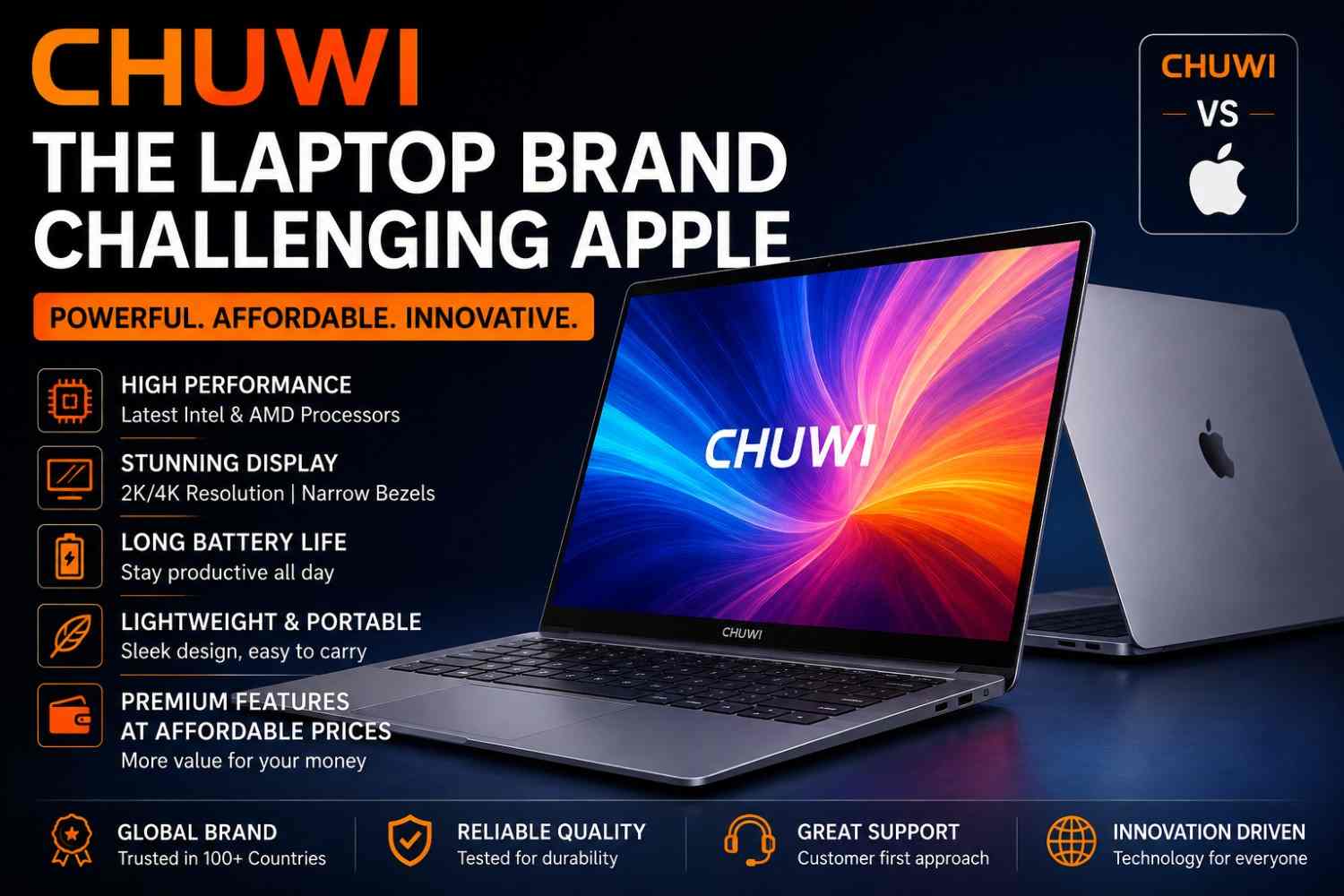

A MacBook Isn’t the Only Premium Laptop Anymore
You may not need to spend MacBook money to get a premium-looking laptop.
That is where CHUWI gets interesting.
If you have been browsing laptops online recently, you may have noticed the CHUWI name appearing beside much more familiar brands such as Apple, Lenovo, HP, ASUS and Acer.
CHUWI is a Shenzhen-based consumer electronics company founded in 2004. The company focuses on laptops, tablets, mini PCs and other computing products, with a business model built heavily around value and online distribution.
But calling CHUWI simply a “cheap laptop brand” would be missing the bigger story.
The company is increasingly moving toward lightweight aluminium laptops, high-resolution displays, AI PCs and more powerful processors.
Its current lineup includes products such as the CoreBook Air 226V, UniBook 304, UniBook 315, MiniBook X U300 and GTBook X 230H.
So the real question is:
Can a relatively affordable Chinese laptop brand actually compete with Apple’s MacBook experience?
The short answer is not completely—but CHUWI is becoming a much more interesting alternative.

What Exactly Is CHUWI?
CHUWI, officially CHUWI Innovation Technology Co., Ltd., is a Chinese consumer electronics manufacturer headquartered in Shenzhen.
The company says it was established in 2004 and has developed products across laptops, tablets and mini PCs. It also says it has more than 150 employees, 60+ senior engineers and partnerships with three major factories.
CHUWI’s strategy is different from Apple’s.
Apple controls almost everything—from the processor and operating system to the hardware design, retail experience and software ecosystem.
CHUWI generally takes a more cost-conscious approach.
It builds Windows-based computers around processors from companies such as Intel and AMD and sells through online channels and distributors.
That helps explain why CHUWI can offer specifications that look surprisingly strong on paper without reaching MacBook-level pricing.
Why Is CHUWI Being Compared With Apple?
The comparison mostly comes from design, portability and specifications, rather than market size.
Take the current CoreBook Air 226V.
CHUWI lists it with a 14-inch 2.8K 120Hz display, Intel Core Ultra 5 226V processor, 16GB RAM and 512GB storage, while keeping the weight around 1.2kg.
Those numbers immediately make people think about premium ultraportables.
And that’s exactly where CHUWI is trying to compete.
The company has increasingly focused on:
- Lightweight aluminium designs
- High-resolution displays
- 120Hz panels
- Intel Core Ultra processors
- Copilot+ PC features
- Large SSDs
- Compact form factors
- Competitive pricing
CHUWI itself describes its CoreBook Air as an ultra-light Copilot+ AI laptop.
But specifications are only one part of a laptop.
Apple’s biggest advantage isn’t simply hardware. It’s the entire ecosystem around the MacBook.
CHUWI vs MacBook: Where Is the Real Difference?
Here’s where things become interesting.
1. Operating system
MacBooks use Apple’s macOS.
CHUWI laptops generally use Windows.
For Indian users, Windows can be particularly convenient if you rely on Microsoft Office, Windows-specific applications, gaming, legacy software or certain engineering tools.
macOS, meanwhile, has advantages for users already invested in Apple’s ecosystem.
2. Processor architecture
Modern MacBooks use Apple’s own silicon, while CHUWI’s newer laptops use processors from Intel or AMD.
For example, the CoreBook Air 226V uses Intel’s Core Ultra 5 226V Lunar Lake platform. CHUWI says the machine is designed around local AI acceleration and Copilot+ PC capabilities.
That gives CHUWI access to the enormous Windows PC ecosystem.
3. Ecosystem
This is probably Apple’s biggest advantage.
If you own an iPhone, AirPods and an iPad, the MacBook can become part of a tightly connected ecosystem.
Features such as AirDrop, iCloud, Handoff and iPhone integration can make everyday workflows easier.
CHUWI doesn’t have an equivalent ecosystem.
That doesn’t make CHUWI bad—it simply means the buying decision is different.
What Makes CHUWI Laptops Interesting in 2026?
The company’s recent products show that it is no longer concentrating exclusively on entry-level machines.
CHUWI’s laptop portfolio now spans several categories, including CoreBook, FreeBook, HeroBook, GemiBook, MiniBook, GTBook, GameBook and UniBook.
That’s a surprisingly broad range.
The CoreBook Air Is the Model to Watch
The CoreBook Air 226V is particularly interesting because it targets the premium ultraportable segment.
CHUWI lists:
- 14-inch display
- 2.8K resolution
- 120Hz refresh rate
- Intel Core Ultra 5 226V
- 16GB memory
- 512GB storage
- Approximately 1.2kg weight
- Copilot+ PC positioning
The combination is clearly designed to attract people who want a thin, modern Windows laptop without automatically jumping to a premium MacBook.
And there is another important trend here:
AI PCs.
Why CHUWI Is Betting on AI PCs
The latest generation of Windows laptops is increasingly being marketed around local AI processing.
Instead of sending every AI workload to a cloud server, some tasks can be processed locally through an NPU—an AI-focused processor inside modern CPUs.
Intel’s Core Ultra platform includes this type of hardware acceleration.
CHUWI says its CoreBook Air 226V can deliver up to 97 total TOPS across its processing hardware for AI workloads.
For most buyers, however, TOPS shouldn’t be the deciding factor.
What matters more is whether the laptop can actually make everyday tasks faster or more useful.
For example:
- AI-assisted productivity
- Background image processing
- Video effects
- Windows AI features
- Local AI applications
- Improved power efficiency
This is still an emerging laptop category, so I would treat AI performance as a useful bonus rather than the primary reason to buy a machine.
CHUWI Also Makes Tiny Laptops
One of the things I find genuinely interesting about CHUWI is its willingness to experiment with unusual form factors.
The MiniBook series is a good example.
CHUWI’s MiniBook N100 has an 8-inch 1920×1200 display, a 360-degree hinge, Intel N100 processor, 16GB LPDDR5 memory and a 512GB SSD. The company lists the magnesium-alloy machine at only about 680 grams.
That’s tiny compared with a conventional 14-inch laptop.
It’s obviously not designed to replace a MacBook Pro for professional video editing.
Instead, it targets people who value extreme portability.
Think:
“I want a real Windows computer that can fit almost anywhere.”
My Real-World Take: Where Would CHUWI Make Sense?
Imagine you’re a college student in India.
You need a laptop for:
- Microsoft Office
- Chrome
- Online classes
- Coding
- YouTube
- Canva
- Basic photo editing
- UPI and banking websites
- Occasional programming
You don’t necessarily need a ₹1 lakh+ premium laptop.
A well-specced CHUWI could potentially provide enough performance for these workloads while leaving more money in your budget.
The same applies to someone who travels frequently.
A 1.2kg laptop is much easier to carry around than a bulky performance notebook.
But if your work depends on professional-grade software, excellent after-sales support or a mature service network, the calculation changes.
That’s where established brands become much more attractive.
What I Like About CHUWI
1. Strong hardware for the money
CHUWI’s biggest selling point remains value.
The company explicitly positions itself around affordable computing, and its current laptops combine modern processors, high-resolution screens and relatively lightweight designs.
2. Interesting designs
CHUWI isn’t afraid to experiment.
The MiniBook line, 3:2-style productivity machines and lightweight CoreBook models show that the company isn’t simply copying one conventional laptop formula.
3. Windows flexibility
For many users, Windows remains incredibly practical.
You can install a huge range of software, connect external hardware and use applications that aren’t available on macOS.
4. AI-focused hardware
Newer CHUWI models are moving toward Intel Core Ultra and Copilot+ PC platforms rather than relying only on low-end processors.
Where CHUWI Still Has Work to Do
This is the section I wouldn’t skip before buying.
After-sales service
Apple has an enormous advantage here.
If you live in a major Indian city, finding Apple service infrastructure is generally straightforward.
With a lesser-known international laptop brand, you should investigate warranty coverage, replacement parts and service availability before placing the order.
Software and driver maturity
Windows hardware can occasionally require driver updates or manufacturer-specific software.
Established brands typically have larger support ecosystems.
Resale value
A MacBook generally holds its resale value better than many lesser-known laptop brands.
That’s worth considering if you upgrade every two or three years.
Brand recognition
CHUWI isn’t Lenovo, HP, Dell or Apple.
That doesn’t automatically mean poor quality, but it does mean buyers should evaluate the specific model rather than purchasing solely because the specification sheet looks impressive.
Is CHUWI Actually “Challenging Apple”?
Yes—but only in a very specific way.
CHUWI isn’t currently challenging Apple at the scale of MacBooks, ecosystem integration or global brand recognition.
Instead, it’s challenging the idea that premium-looking hardware must always carry a premium price.
That’s a much more realistic description.
The company has moved from basic affordable laptops toward AI PCs, lightweight machines and higher-end specifications.
Its 2026 lineup includes Core Ultra-based laptops and gaming models, showing how aggressively the company is expanding beyond entry-level computing.
CHUWI vs Apple MacBook: Quick Comparison
| Feature | CHUWI | Apple MacBook |
|---|---|---|
| Operating system | Windows | macOS |
| Typical value proposition | High specifications for the price | Premium hardware + ecosystem |
| Processor options | Intel / AMD | Apple silicon |
| Gaming | Generally better compatibility | More limited game library |
| iPhone integration | Limited | Excellent |
| Hardware variety | Very broad | More controlled |
| Resale value | Usually weaker | Usually stronger |
| After-sales ecosystem | Depends on region/model | Stronger |
| Portability | Excellent on selected models | Excellent |
| Budget options | Stronger | Limited |
The table tells the story pretty well.
CHUWI wins on flexibility and value. Apple wins on ecosystem, software integration and long-term premium positioning.
Should You Buy a CHUWI Laptop?
I wouldn’t recommend buying one simply because someone says it is a “MacBook killer.”
That’s marketing language.
Instead, check five things before buying:
- Exact processor
- RAM and whether it is upgradeable
- SSD capacity and upgrade options
- Display quality
- Warranty and service availability in India
Also check the exact seller and return policy.
A great specification sheet doesn’t automatically make a great laptop.
Who Should Consider CHUWI?
CHUWI makes the most sense for:
- Students
- Budget-conscious professionals
- Frequent travellers
- Windows users
- Programmers
- Office users
- People who want unusual compact laptops
- Buyers who prioritize specifications per rupee
Who Should Probably Stick With Apple?
A MacBook may be the better choice if you:
- Already use an iPhone and iPad
- Want strong ecosystem integration
- Need macOS-specific software
- Prioritize long-term resale value
- Want a mature premium support network
- Don’t mind paying more for the overall experience
Final Verdict: Is CHUWI Worth Paying Attention To?
Absolutely.
I wouldn’t call CHUWI an Apple replacement for everyone.
But I would call it a brand worth watching.
Its evolution from affordable Windows hardware toward lightweight AI laptops, premium displays and more powerful processors is significant. The company’s own product history shows a deliberate move into higher-end computing categories.
For someone shopping on a strict budget, CHUWI can be particularly interesting.
But don’t buy the logo—or the headline.
Buy the specific laptop.
Check the processor, display, thermals, battery, keyboard, ports, upgradeability and Indian warranty situation.
That’s the difference between finding a genuine bargain and simply buying a cheap laptop.
Frequently Asked Questions
Is CHUWI a Chinese laptop brand?
Yes. CHUWI Innovation Technology is based in Shenzhen, China, and the company says it was established in 2004.
Is CHUWI a good laptop brand?
CHUWI can be a good option when its price and specifications are competitive, especially for students, office users and people looking for lightweight Windows laptops. However, buyers should check model-specific reviews, warranty coverage and service availability before purchasing.
Is CHUWI better than Apple?
Not overall.
CHUWI can offer attractive hardware specifications and Windows flexibility for less money, while Apple has major advantages in ecosystem integration, software optimization, support and resale value.
Where are CHUWI laptops made?
CHUWI is headquartered in Shenzhen and works with manufacturing partners. The company says it maintains strategic partnerships with three A-level factories.
Does CHUWI make AI laptops?
Yes. Its current lineup includes AI-focused models such as the CoreBook Air 226V, which uses Intel’s Core Ultra 5 226V platform and is marketed as a Copilot+ PC.
The Bottom Line
CHUWI isn’t the next Apple—not yet, and probably not in the way many headlines suggest.
But it is doing something that matters for laptop buyers:
putting premium-looking hardware, modern processors and high-resolution displays into a much more value-focused package.
If Apple represents the premium ecosystem approach, CHUWI represents the “give me more hardware for my money” approach.
And for many students and budget-conscious Indian buyers, that distinction could be more important than the logo on the lid.












[…] What Is CHUWI, The Laptop Brand Challenging Apple? […]