
Google vs Microsoft 2026: The $370 Billion War That’s Quietly Changing the Internet
Home › Big Tech › Google vs Microsoft
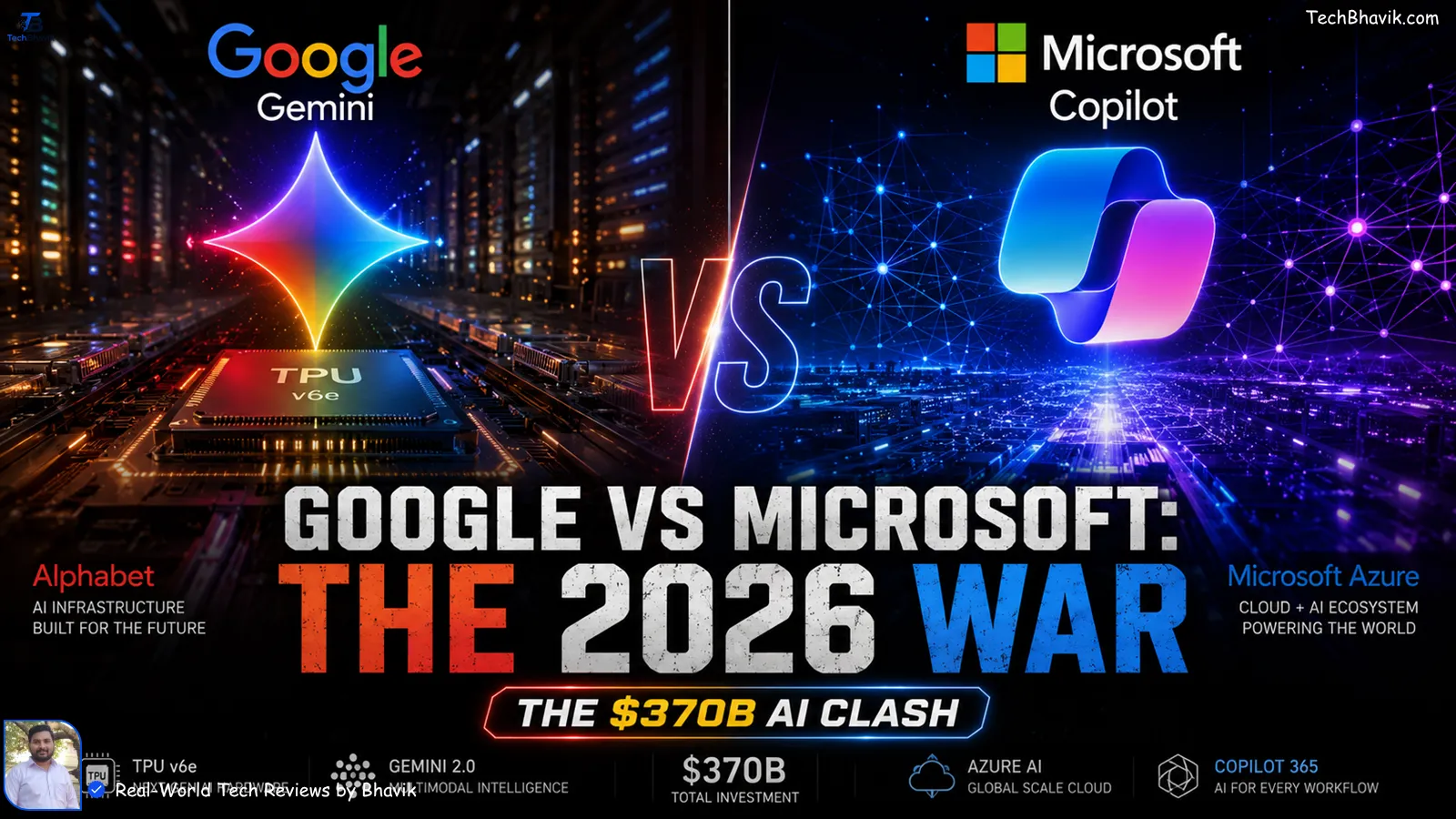
Google vs Microsoft: Who Really Wins the Battle for the Future of Tech?
Search, AI, cloud, productivity, advertising — Google and Microsoft, the two most powerful tech companies in the world, are fighting across every front simultaneously. Here is the definitive 2026 breakdown, backed by real numbers.
📋 Table of Contents
Two tech titans. One planet. Both spending $190 billion in a single year. Both convinced that artificial intelligence is the most important technology race in human history. Both building data centers fast enough that the world’s power grids are struggling to keep up.
Google and Microsoft have been competitors for decades — but 2026 is different. The AI era has transformed a rivalry that was once mostly about search versus Office software into a full-spectrum war across cloud computing, artificial intelligence, productivity, advertising, hardware, and developer ecosystems.
And here is the genuinely fascinating part: for the first time, the outcome isn’t obvious. Google — with more search traffic, more AI research talent, more profitable quarters, and more daily active users than any other internet company — could still lose certain battles it should be winning. Microsoft — the company that built Windows, Excel, and Internet Explorer — has quietly become one of the most exciting AI stories in tech, riding a $10 billion Copilot business and Azure’s relentless cloud growth.
Let’s go section by section. Real numbers. Honest analysis. No hype.
[ Google AdSense — Replace with your responsive ad unit code ]
🔍 Round 1: Search — Google’s 90% Kingdom vs Bing’s AI Comeback
If there is one battle Google has won so completely it barely feels like a battle anymore, it is search. It controls 91.4% of the global search market, processes 8.5 billion searches per day, and generates $307 billion in annual ad revenue. “Googling” something is so embedded in language that it became a verb in the Oxford English Dictionary.
And yet — cracks are appearing for the first time in a generation.
58 to 62% of Google searches now end without a click, AI Overviews appear on 25%+ of queries, and 15% of daily searches have never been seen before. Zero-click searches hurt the websites and publishers that built their traffic on Google. They also represent a subtle business risk for Google itself — if users never click through to websites, the AdSense ecosystem that funds content creation starts to hollow out.
So where does Microsoft‘s Bing stand? Globally, Google accounts for around 90% of global search engine usage across all platforms in 2026. Bing reached 10.48% in the U.S., its highest-ever share. Microsoft’s integration of Copilot AI across Windows, Edge, and Office 365 drove the growth.
That number understates Bing’s real commercial impact. The market share number undersells Bing’s commercial impact because Bing visitors skew older, desktop-heavy, and B2B-leaning — visitors further down the buying funnel. A Bing user is often an enterprise professional inside a Windows machine. That profile converts better for B2B advertising.
The AI angle adds a new dimension. Google search advertising revenue is projected to exceed $230 billion in 2026, while Bing-powered search and news advertising revenue is on track to reach about $19.5 billion. That gap is enormous — but Bing is growing. Microsoft announced that Bing reached 1 billion monthly active users for the first time, with search ad revenue up 12%.
☁️ Round 2: Cloud — Azure vs Google Cloud (The Real War)
If search is Google’s fortress, cloud is the battlefield where the outcome is genuinely uncertain — and where the most money is being made and lost right now.
Microsoft Azure has been the #2 cloud player for years, trailing Amazon Web Services but comfortably ahead of Google Cloud. But the AI boom is changing the rankings in real time, and the story of Q1 2026 is genuinely remarkable: Google Cloud is growing faster than Azure.
Google Cloud reached $20 billion in quarterly revenue, growing faster than Amazon Web Services ($37.6 billion total) and Microsoft’s Azure-driven cloud segment ($34.7 billion total). Google Cloud revenues grew 63% with backlog nearly doubling quarter on quarter to over $460 billion.
Azure is still larger in absolute revenue — Microsoft Cloud revenue crossed $50 billion this quarter, reflecting strong demand for its portfolio of services. But Google Cloud’s growth rate at 63% year-over-year is staggering, and its backlog tells the real future story: Google Cloud’s enterprise cloud computing segment backlog is $462 billion, which nearly doubled this quarter compared to last quarter.
Azure’s massive existing virtual machine footprint means that every new AI service rides on already depreciated data center assets. Microsoft’s CFO noted that Azure’s capital expenditure per dollar of AI revenue was declining for the fourth consecutive quarter. That is a powerful efficiency advantage. But Google is closing the gap faster than most analysts expected.
[ Google AdSense — Paste your mid-content responsive ad unit here ]
🤖 Round 3: Artificial Intelligence — Gemini vs Copilot
This is the round everyone is watching most closely, and it’s also the most complicated to call.
Google has more AI research talent than any company on Earth. DeepMind, Google Brain, and the teams behind Gemini represent decades of investment in fundamental AI research. The number of paid subscriptions has now reached 350 million, with YouTube and Google One being the key drivers. Paid monthly active users of Gemini Enterprise grew 40% over the last quarter.
Microsoft’s play is strategically different — and arguably smarter for the near term. Rather than building everything from scratch, Microsoft invested early in OpenAI — the company behind ChatGPT — and integrated that AI deeply into every product it sells. Microsoft Copilot is now embedded in Word, Excel, PowerPoint, Teams, Outlook, Azure, Windows 11, and Edge. It is AI embedded into the workflow of enterprise workers who already use these tools every day.
- Powers Google Search AI Overviews
- Integrated into Gmail, Docs, Sheets
- Powers Apple Siri (major win)
- 350M paid subscribers across ecosystem
- Gemini Enterprise: 40% MAU growth
- Google’s own custom TPU hardware
- $10B+ annual recurring revenue
- Built into Word, Excel, PowerPoint
- Teams, Outlook, Azure, Windows 11
- Copilot for Security — new product
- Bing-powered AI chat (1B MAU)
- OpenAI partnership + Anthropic access
Who is winning? In terms of AI revenue, Microsoft’s Copilot’s $10B+ ARR is more concrete and enterprise-monetised. In terms of reach, Google’s AI touches more people daily — Gemini is in Search, YouTube, Android, Chrome, and now iPhones. In terms of underlying capability, it is genuinely too close to call.
What gives Google a structural advantage in AI is infrastructure: its custom Ironwood TPU chips and data center scale. Google Cloud boss Thomas Kurian credited the company’s strategy of building custom AI chips, foundation models, and products in-house for giving it a cost and research advantage over competitors.
💼 Round 4: Productivity Tools — Office 365 vs Google Workspace
This is the battle being fought on your laptop right now. Which suite do you use for email, documents, spreadsheets, and collaboration? For most businesses, the answer defines which of these two companies gets a monthly subscription payment — and whose AI assistant gets to live inside your workflow.
| Feature | 🔵 Google Workspace | 🟦 Microsoft 365 |
|---|---|---|
| Core Apps | Docs, Sheets, Slides, Gmail, Meet | Word, Excel, PowerPoint, Outlook, Teams |
| Strength | Real-time collaboration, browser-based | Industry-standard formats, enterprise depth |
| AI Integration | Gemini in Docs, Gmail, Meet | Copilot in every app ($30/user/month) |
| Enterprise Dominance | Strong in startups & education | Dominant in enterprise & government |
| Lock-in Level | Medium — easy to switch | Very high — deeply embedded in workflows |
Microsoft’s moat here is formidable. The combination of Excel (which still runs global finance), Outlook (the default corporate email client), Teams (which became the default video conferencing tool during and after the pandemic), and now Copilot embedded into all of these creates an extraordinarily sticky ecosystem. Switching a company from Microsoft 365 is expensive, disruptive, and politically difficult. That lock-in is Microsoft’s most valuable long-term asset.
[ Google AdSense — 300×250 Rectangle (best mid-article placement) ]
📣 Round 5: Advertising — Google’s Cash Machine vs Microsoft’s Challenger
Advertising is where Google truly has no peer. It is not a competition — it is an empire.
Google Search had a strong quarter with AI experiences driving usage, queries at an all time high, and 19% revenue growth. Google’s advertising machine — spanning Search ads, YouTube ads, Display ads, and its publisher network (AdSense) — is the most profitable advertising system ever built by any company in human history.
For advertisers, there is a nuanced choice here. Google’s offering predates Bing’s by six years. Google’s advertising offering is more expensive, has a larger reach, and offers more advantages. But Bing Ads (Microsoft Advertising) is a cheaper alternative with 33% lower CPCs on average and less competition. For a small business or a startup, Bing Advertising can deliver better return on ad spend — especially for B2B or enterprise audiences.
💰 Round 6: Revenue & Financial Health
Numbers don’t lie. Let’s look at what the Q1 2026 earnings actually showed for both companies.
Google’s quarter was extraordinary. Net income increased 81% and EPS increased 82% to $5.11. The company announced a 5% increase to the dividend. Alphabet posted an 81% increase in net income to $62.6 billion on revenue of $110 billion. That is a level of profitability that even other tech giants struggle to match.
Microsoft’s quarter was equally strong in its own right. Microsoft Cloud revenue crossed $50 billion this quarter, reflecting the strong demand for the portfolio of services. Azure and other cloud services revenue increased 39%. Microsoft returned $12.7 billion to shareholders in the form of dividends and share repurchases, an increase of 32% compared to the same quarter last year.
🚀 Round 7: The AI Investment Race — $370 Billion Being Spent This Year
This is the round that defines the next decade. Both companies are spending at a scale that would have been unimaginable five years ago — and both are doing it because they believe AI infrastructure spending today translates directly into cloud revenue, AI product dominance, and competitive lock-in for the next decade.
Alphabet raised its full year 2026 capex spending guidance to $180 billion to $190 billion, up from $175 billion to $185 billion. Microsoft CFO Amy Hood said it expects to invest $190 billion in total this year.
Together, that is $370–380 billion from just two companies in a single calendar year. Add Amazon ($150B+) and Meta ($65B+) and you reach the figure that made headlines earlier this year: Google, Amazon, Microsoft, and Meta collectively plan to spend $725 billion on capex in 2026, up 77% from last year’s record $410 billion.
What’s the money being spent on? Data centers, Nvidia GPUs (both), custom AI chips (Google’s Ironwood TPUs, Microsoft’s Maia AI chips), power infrastructure, fibre networks, and the software engineers to glue it all together. The scale of this investment is why both companies’ stock prices have been rewarded despite the massive spending: investors believe the revenue returns will justify the cost.
⚖️ Final Verdict: Who Is Actually Winning?
Here is the honest answer: they’re winning in different dimensions — and both are winning decisively against everyone else.
| Battle Arena | Winner | Why |
|---|---|---|
| 🔍 Search | Google 🏆 | 90% global share, $230B+ ad revenue. No contest. |
| ☁️ Cloud Revenue Size | Microsoft 🏆 | $34.7B quarterly vs $20B. Azure larger today. |
| 📈 Cloud Growth Rate | Google 🏆 | 63% vs 40%. Google Cloud closing gap fast. |
| 🤖 AI Monetisation | Microsoft 🏆 | Copilot $10B ARR. Concrete enterprise revenue. |
| 🤖 AI Infrastructure | Google 🏆 | Custom TPUs, DeepMind, full AI stack in-house. |
| 💼 Enterprise Productivity | Microsoft 🏆 | Office 365 lock-in + Copilot embedded everywhere. |
| 📣 Advertising | Google 🏆 | $230B+ vs $19.5B. Not close. |
| 💰 Profitability | Google 🏆 | $62.6B net income in one quarter (+81%). |
| 📱 Consumer Products | Google 🏆 | Android, Chrome, Maps, YouTube, Gmail dominate. |
By our count, Google wins more categories — but that framing misses something important. Microsoft’s three wins (cloud revenue, AI monetisation, enterprise productivity) are the three fastest-growing, highest-margin areas of the 2026 tech economy. Google’s wins include Search and Advertising — both of which face genuine disruption risk from AI over the next decade.
The most honest conclusion: Google is bigger, more profitable, and wins more categories today. Microsoft has better momentum in the areas that will matter most tomorrow. Both are exceptional businesses. Both are executing well. Both will be more powerful in 2030 than they are now.
The real loser in this story? Everyone else. Between Google and Microsoft, the battlegrounds that define modern technology are being fought by two entities with nearly unlimited capital, world-class talent, and the AI infrastructure to reshape every industry they touch. For the rest of the tech world, the question isn’t “who wins?” It’s: where is the space left to compete?
❓ Frequently Asked Questions
[ Google AdSense — Below-content leaderboard or responsive unit ]
Google wins on revenue, profitability, search, advertising, and consumer products. Microsoft wins on enterprise software, AI monetisation, and cloud growth momentum. Both are spending $190 billion building the AI infrastructure that will define the next decade. Neither is going away. Neither is losing.
The real question for 2027 and beyond: can Google convert its AI research and cloud growth into enterprise lock-in the way Microsoft has? And can Microsoft find its own version of YouTube, Android, or Search — a consumer product with the scale and daily usage that Google’s services command?
TechBhavik will keep tracking it. Bookmark us and check back for quarterly updates every earnings season.
More Big Tech Analysis on TechBhavik →📖 Recommended Reading
Highest Paying Programming Languages to Learn in 2026
Discover which coding languages command the biggest paychecks and dominates the tech industry this year.
Blueprint for Scoring Remote Freelance Tech Jobs With Zero Experience
A complete step-by-step roadmap to land your first remote tech client without a portfolio.