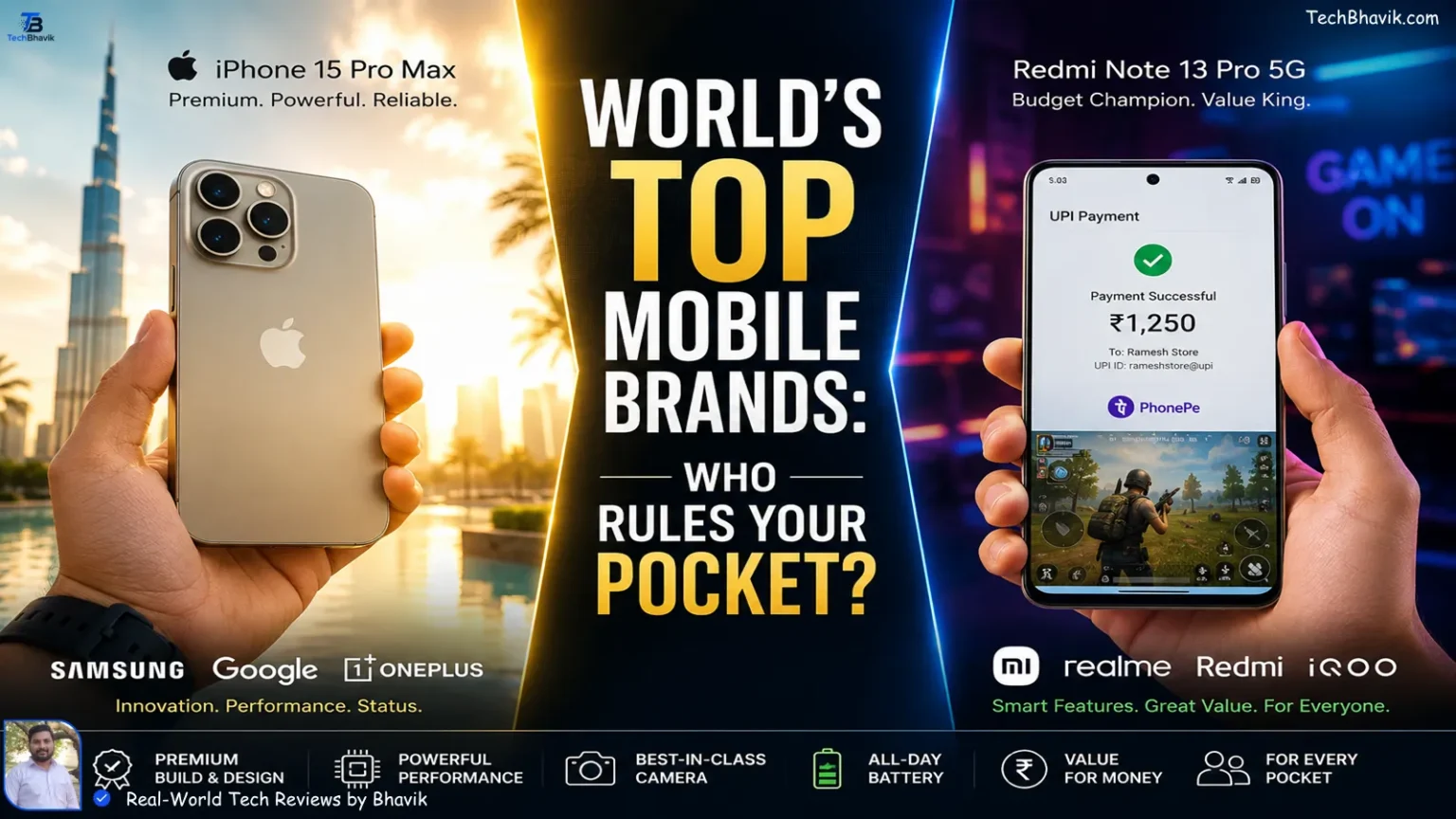
World’s Top Mobile Companies:
Founded, Owned & Ruling in 2026
From Nokia’s 1865 paper mill in Finland to Apple’s 2007 iPhone revolution — the complete story of every mobile giant: who founded them, who owns them today, their global market share, and how many phones they have built.
Think about the phone in your pocket right now. It’s the result of 160+ years of human ambition, corporate battles, technological revolutions, and extraordinary founders who refused to accept that the world couldn’t be different. The mobile industry, from Nokia’s humble paper mill origins to Samsung’s $300 billion empire, is one of the greatest business stories ever told.
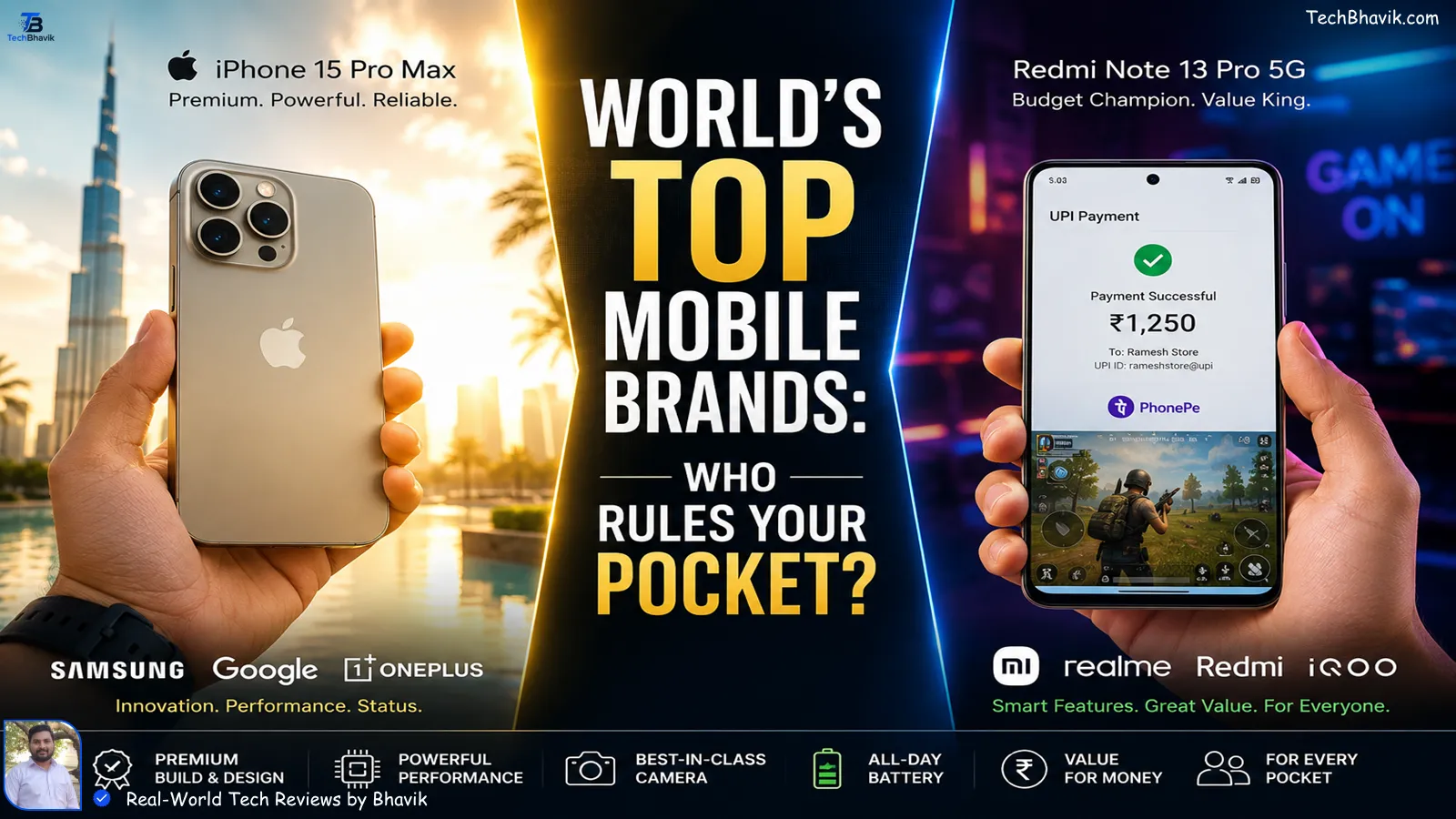
In 2026, the top 10 mobile phone brands globally are Samsung, Apple, Xiaomi, OPPO, Vivo, Huawei, Realme, Motorola, OnePlus, and Google Pixel. The industry produces over 1.2 billion smartphones per year and is expected to grow into a $932 billion market by 2033. But behind every brand is a story — a founder with a vision, a moment of crisis, a product that changed everything. This article tells those stories.
Global Smartphone Market: The 2026 Landscape
Before we dive into individual company stories, it helps to understand the battlefield they’re all competing on. 293.8 million smartphones were shipped worldwide in Q1 2026 — down 2.9% year-over-year, as rising component costs squeeze margins and volume. Samsung’s Q1 2026 share rose to 21.2%, and Apple’s rose to 21.0% — making them nearly dead equal at the top of the market.
| Rank | Company | Founded | HQ Country | Q1 2026 Share | Approx. Annual Shipments | Status |
|---|---|---|---|---|---|---|
1 | Samsung | 1938 | South Korea | 21.2% | 225–240M / year | Active ✅ |
2 | Apple | 1976 | USA | 21.0% | 220–235M / year | Active ✅ |
3 | Xiaomi | 2010 | China | 12–13% | 145–160M / year | Active ✅ |
4 | Huawei | 1987 | China | ~3% | ~35–40M / year | Restricted ⚠️ |
5 | Google Pixel | 1998 | USA | ~3% | ~10–12M / year | Active ✅ |
6 | OnePlus | 2013 | China | ~1.5% | ~12–15M / year | Active ✅ |
7 | Nokia | 1865 | Finland | <1% | ~5M / year (HMD) | Licensing ⚠️ |
8 | LG | 1958 | South Korea | 0% | 0 (exited 2021) | Exited ❌ |
🌲 The Extraordinary Origin Story
Nokia began in 1865 when mining engineer Fredrik Idestam established a ground wood pulp mill on the banks of the Tammerkoski rapids in the town of Tampere, in southwestern Finland. If you told Fredrik Idestam that his paper mill would one day be the most important mobile phone company on Earth — commanding 40% of the global handset market and teaching billions of people what a “cell phone” felt like — he would have thought you deeply confused. But that is exactly what happened.
The 1967 merger of Nokia Ab, Finnish Rubber Works and Finnish Cable Works created the modern Nokia Corporation conglomerate, diversifying into rubber boots, televisions, and eventually telecommunications. Nokia entered the mobile phone business properly in the early 1990s — and within a decade, had made the mobile phone accessible to ordinary people worldwide.
📱 The Mobile Phone Revolution
The Nokia 1100, launched in 2003, became the best-selling electronic device in human history — with over 250 million units sold. The Nokia 3310, launched in 2000, became a cultural icon so durable it spawned internet memes that persist to this day. By 2007, Nokia held over 40% of the entire global mobile phone market — a dominance almost unparalleled in consumer electronics history.
Then Steve Jobs walked onto a stage in San Francisco and introduced the iPhone. Nokia, which had actually pioneered touchscreen technology internally but chose not to pursue it aggressively, found itself on the wrong side of history. In 2009, Nokia made history by appointing Stephen Elop, a former executive at Microsoft, as CEO — the first CEO of Nokia who was not Finnish. The 2011 partnership with Microsoft to build Windows Phone devices failed to reverse the decline. In 2014, Nokia sold its mobile phone business to Microsoft for $7.2 billion.
🔭 Nokia Today: A New Chapter
Today’s Nokia is not a phone company. It is a global telecommunications infrastructure giant — building the 5G networks that carry the world’s data. Nokia’s Networks division is the world’s fourth-largest telecom equipment manufacturer, competing with Huawei, Ericsson, and Cisco. The Nokia brand name lives on in smartphones through HMD Global, a Finnish company that licenses the Nokia brand and makes Android phones — particularly popular in India and Southeast Asia for their software purity and affordable pricing.
Nokia’s Legacy Wins
- Invented the mass-market mobile phone
- Nokia 1100 — best-selling device in history
- Pioneered SMS text messaging culture
- Made phones affordable for billions
The Fall Lessons
- Missed the touchscreen smartphone revolution
- Carrier conflict killed its software ecosystem
- Microsoft acquisition destroyed the brand
- Internal culture resisted necessary change
- 1865 — Fredrik Idestam founds paper mill in Tampere, Finland
- 1967 — Nokia Corporation formed from merger of three Finnish companies
- 1987 — Nokia launches its first handheld mobile phone (Mobira Cityman 900)
- 1994 — Nokia 2100 launched, targeting 400,000 sales — sold 20 million
- 1999 — Nokia becomes world’s most valuable brand; controls 27% of handset market
- 2003 — Nokia 1100 launches, sells 250M units — most sold device ever
- 2007 — Peak market share: 40%+. Apple introduces the iPhone.
- 2014 — Nokia sells mobile business to Microsoft for $7.2 billion
- 2016 — HMD Global formed, licenses Nokia brand for Android phones
- 2026 — Nokia is a $22B telecom infrastructure company; Pekka Lundmark, CEO
🌾 From Noodles to the World’s #1 Phone Brand
Samsung was founded on March 1, 1938 — not as a tech company, not as an electronics firm, but as a grocery trading business. Lee Byung-chul, a 27-year-old from Uiryeong, South Korea, started Samsung (“Three Stars” in Korean) with 30,000 won of capital, selling dried fish, vegetables, and noodles to Manchuria and Beijing. The humble beginning of what would become the world’s largest smartphone brand is a story almost too remarkable to believe.
Samsung moved into electronics in 1969, manufacturing black-and-white televisions. The company entered the mobile phone business in 1988 with its first analogue cellular phone — the SH-100. But it was the 2010 launch of the Samsung Galaxy S that changed everything. Samsung recognised before almost anyone else that Android could compete with iPhone, and built the most comprehensive Android hardware ecosystem on Earth.
👑 The Galaxy Empire
Samsung’s Galaxy line spans every price segment imaginable — from the $100 Galaxy A13 to the $1,200 Galaxy S26 Ultra. The company ships over 225 million smartphones per year, across 1,389+ models launched since 2010. Samsung doesn’t just make phones — it manufactures the chips, screens, memory, and cameras inside phones made by Apple, Google, Xiaomi, and almost every other brand. The company supplies 40% of the world’s OLED smartphone displays.
Samsung’s Q1 2026 share rose to 21.2%, narrowly leading Apple. The Galaxy S26 series, Galaxy Z Fold 7, and the explosive growth of the Galaxy A-series in emerging markets including India are driving this leadership. Samsung remains particularly dominant in India, Africa, and Southeast Asia, where the A-series provides flagship-adjacent specs at accessible price points.
Current leadership: Lee Byung-chul’s grandson, Lee Jae-yong (Jay Y. Lee), serves as Executive Chairman of Samsung Electronics. The Lee family holds approximately 21% of Samsung Life Insurance, which holds significant Samsung Electronics shares — a complex cross-shareholding structure that has been the subject of ongoing South Korean governance debates.
- 1938 — Lee Byung-chul founds Samsung as a trading company in Suwon
- 1969 — Samsung Electronics founded; first product: black-and-white TV
- 1988 — Samsung SH-100: first Samsung mobile phone (analogue)
- 2010 — Galaxy S launches. Samsung bets everything on Android. It pays off.
- 2012 — Samsung overtakes Nokia as world’s largest phone manufacturer
- 2014 — Galaxy Note 4 and S5 push Samsung to 25%+ global market share
- 2019 — Galaxy Fold: Samsung pioneers the foldable smartphone era
- 2023 — Galaxy S23 series: first to use Snapdragon exclusively in all markets
- 2026 — Galaxy S26, Z Fold 7 launched; Q1 2026 share: 21.2%
🏭 From Lucky Goldstar to Global Phone Brand
LG Electronics’ roots go back to Koo In-hwoi, who founded Lucky Chemical Industrial Company in 1947 — making Korea’s first domestic plastic products, including combs and toothbrushes. In 1958, he founded Goldstar (which later became LG Electronics), producing Korea’s first domestic radio. The name “LG” comes from the merger of Lucky and Goldstar. The company’s slogan, “Life’s Good,” was introduced in 1999.
LG entered the mobile phone business in the mid-1990s and became one of the world’s most innovative smartphone brands — responsible for the world’s first full-touchscreen phone (LG Prada / KE850, 2006 — actually launched months before the iPhone), the first phone with a dual rear camera (LG V10, 2015), and the first phone with a wide-angle front camera. LG’s G and V series were genuinely beloved by audiophiles and power users for their exceptional DAC audio quality and expandable storage when Samsung had abandoned both.
💔 The Tragic Exit
LG, once in third place until 2020, completely exited the smartphone business by 2022. After six straight years of losses in its mobile division (totalling approximately $4.4 billion in accumulated losses), LG officially shut down its mobile phone business in April 2021. The last LG phone, the LG Velvet 2 Pro, was a South Korea-only release.
LG’s failure was a perfect storm of factors: late to premium Android, a confusing naming strategy, poor camera quality in key years (2017–2019), and the inability to build the kind of ecosystem and brand loyalty that Apple and Samsung had cultivated. LG Electronics continues as a massive company in home appliances, OLED TVs, electric vehicle components, and B2B technology — but the phone chapter is permanently closed.
- 1947 — Koo In-hwoi founds Lucky Chemical Company in Korea
- 1958 — Goldstar founded; produces Korea’s first domestic radio
- 1995 — LG enters mobile phone market
- 2006 — LG Prada (KE850): world’s first full-touchscreen phone, before iPhone
- 2013 — LG G2 acclaimed as best Android phone of the year; peak market share ~6.5%
- 2015 — LG V10: world’s first dual rear camera smartphone
- 2015–2020 — Six consecutive years of mobile division losses
- 2021 — LG officially exits the smartphone market (April 5, 2021)
🍎 The Garage Where It All Began
On April 1, 1976 — April Fool’s Day — Steve Jobs, Steve Wozniak, and Ronald Wayne signed the papers that created Apple Computer. Wayne, famously risk-averse, sold his 10% stake for $800 twelve days later — a stake now worth hundreds of billions of dollars. The company was initially built in Jobs’ parents’ garage in Los Altos, California, building personal computers for hobbyists.
Apple’s path to becoming a phone company was not obvious. For three decades, Apple made computers and music players. Then, in January 2007, Steve Jobs stood on a stage and announced that Apple was about to release “a revolutionary product” — and introduced the original iPhone with the words: “An iPod, a phone, and an internet communicator. These are not three separate devices. This is one device.” The audience laughed. Most of the phone industry didn’t. They should have.
📱 The iPhone That Changed Everything
The original iPhone, launched June 29, 2007, had no App Store, no copy-paste, and cost $499. It also invalidated every existing smartphone within months. Nokia, BlackBerry, Palm, and Motorola all scrambled to respond — and all largely failed. Apple had invented a new paradigm: the touchscreen smartphone as a pocket computer, not a phone with internet access.
By 2026, Apple has sold over 2.5 billion iPhones since 2007. Apple’s Q1 2026 share rose to 21.0%, nearly matching Samsung in volume. Apple leads Samsung comprehensively in revenue — a $599 iPhone generates far more profit than a $199 Galaxy A series device. Apple’s iPhone ecosystem — App Store, iCloud, AirPods, Apple Watch, Apple Pay — creates a switching cost that keeps users loyal for years or decades.
Tim Cook, who became CEO after Jobs’ passing in October 2011, has transformed Apple from a product company into a services powerhouse. Apple Services (App Store, iCloud, Apple Music, Apple TV+) now generate over $85 billion annually — growing faster than hardware. The largest institutional investors in Apple include Vanguard Group, BlackRock, and Berkshire Hathaway (Warren Buffett). No individual controls Apple — it is publicly traded (NASDAQ: AAPL).
- 1976 — Steve Jobs, Wozniak & Wayne found Apple in Los Altos garage
- 1984 — Macintosh launched — “1984” Super Bowl ad changes advertising forever
- 1997 — Jobs returns after 12-year exile; Apple was weeks from bankruptcy
- 2001 — iPod launches, saving Apple with music hardware
- 2007 — iPhone launches. The mobile industry is never the same.
- 2008 — App Store opens. Third-party apps transform the phone.
- 2010 — iPhone 4 with Retina Display; iPad launched same year
- 2011 — Steve Jobs passes away (October 5). Tim Cook becomes CEO.
- 2017 — iPhone X: Face ID, OLED, notch — another paradigm shift
- 2020 — Apple Silicon (M1) begins; Apple becomes $2T company
- 2026 — iPhone 17 series; Apple Intelligence AI deeply integrated
🏗️ From Telephone Switches to World #1 (Briefly)
Ren Zhengfei was a 44-year-old former military engineer with $3,000 (about ¥21,000) in savings when he founded Huawei in Shenzhen in 1987 — in a small apartment, selling imported telephone exchange equipment from Hong Kong. His vision was audacious: build a Chinese company that could compete with Ericsson, Nokia, and Motorola in telecommunications. The rest of the industry was politely dismissive. They were catastrophically wrong.
Huawei spent its first decade building its own technology rather than licensing foreign components — investing 10%+ of annual revenue in R&D consistently. By 2000, it was building mobile network infrastructure. By 2010, it was the world’s second-largest telecom equipment maker. And by 2020, Huawei briefly became the world’s largest smartphone brand — surpassing Samsung in Q2 2020, the first time a Chinese brand had ever led the global market.
⚠️ The US Trade Restrictions: A Corporate Earthquake
Huawei consistently challenged Apple and Samsung for position at the top of the market, even leading it in the second quarter of 2020. Huawei has not appeared in the top five since the second quarter of 2021, largely as a result of trade restrictions. The US government’s decision to cut Huawei off from Google Mobile Services (Google Maps, Play Store, Chrome) and TSMC’s advanced chips was a devastating blow. No Android phone without Google services can compete globally.
Huawei’s response has been remarkable in its ambition — developing its own HarmonyOS, its own Kirin chips (now limited to older nodes), and a domestic Chinese supply chain. In China, Huawei is staging a recovery — the Mate 60 Pro’s launch in 2023 with a domestically-made 7nm chip was seen as a geopolitical statement as much as a product launch. Internationally, the road back remains blocked.
- 1987 — Ren Zhengfei founds Huawei in Shenzhen with $3,000
- 1997 — First international contract; begins building global telecom network
- 2004 — Huawei launches its first commercial UMTS product
- 2010 — Huawei Ascend launches; enters premium smartphone segment
- 2018 — P20 Pro: first triple-camera smartphone; world-class Leica cameras
- 2019 — US trade restrictions begin; Huawei cut off from Google services
- 2020 — Briefly overtakes Samsung as #1 global smartphone brand (Q2)
- 2021 — Drops out of global top 5 entirely due to chip restrictions
- 2023 — Mate 60 Pro launched with China-made 7nm chip; HarmonyOS grows
- 2026 — Recovering in China (~3% global share); HarmonyOS 5.0 launched
🔍 Two PhD Students and a World-Changing Algorithm
Larry Page and Sergey Brin were Stanford PhD students in 1996 when they began working on a research project called “BackRub” — a search engine that ranked web pages by the number of other pages linking to them. They incorporated Google on September 4, 1998 in a friend’s garage in Menlo Park, California, with $100,000 in initial investment from Sun Microsystems co-founder Andy Bechtolsheim. The name “Google” was a misspelling of “googol” — the number 1 followed by 100 zeros — reflecting their mission to organise the world’s infinite information.
Google’s entry into mobile hardware wasn’t through phones initially — it was through Android, acquired in 2005 for $50 million. Android became the world’s most widely used mobile operating system, running on 72% of all smartphones globally. Google first made phones under the Nexus brand (2010–2016, partnering with HTC, Samsung, and LG). The Pixel line launched in October 2016 — Google’s own hardware, designed entirely in-house.
📱 Why Pixel Matters Despite Small Numbers
The Pixel line is not about volume — it’s about influence. Google uses Pixel to showcase the ultimate Android experience, to develop and demonstrate AI camera capabilities, and to introduce new Google AI features to the world first. By 2024, Pixel production reached 10.5 million units, making Google the third-largest vendor globally by certain measurements, though this understates its true reach.
What Google’s Pixel phones lack in market share, they more than make up in influence. The Night Sight feature (extraordinary low-light photography with computational processing) was first launched on Pixel and has since been copied by every Android manufacturer. Google Tensor chips, designed in-house, run on-device AI for features like Live Translate, Call Screen, and Magic Eraser — innovations that have become industry standard years later on other platforms. The Pixel 10 series (2026) runs deeply integrated Google Gemini AI across photography, search, and productivity.
Sundar Pichai, born in Madurai, Tamil Nadu, India, has been CEO of Google since 2015 and CEO of parent company Alphabet since 2019. His appointment is a source of immense pride in India — he represents one of the most powerful Indian-origin executives in global technology.
- 1996 — “BackRub” project begins at Stanford by Page & Brin
- 1998 — Google Inc. incorporated in a Menlo Park garage
- 2004 — Google IPO; world’s most powerful search engine
- 2005 — Google acquires Android Inc. for $50 million
- 2008 — Android OS launches on T-Mobile G1 (HTC Dream)
- 2010 — Nexus One: Google’s first branded phone (made by HTC)
- 2015 — Sundar Pichai becomes Google CEO
- 2016 — Pixel 1: first true “Made by Google” phone
- 2021 — Tensor chip: Google designs its own mobile processor
- 2026 — Pixel 10 series: deepest Gemini AI integration in any phone
⚡ From 8 Founders to $100 Billion Company in 12 Years
Lei Jun was already a legendary figure in Chinese tech before he founded Xiaomi. Having built and sold software company Kingsoft, he started Xiaomi on April 6, 2010 with 7 co-founders in a small office in Beijing — with a mission to make flagship-quality smartphones at prices that would make other manufacturers embarrassed. The business model was radical: sell hardware at near cost, make profit from software, apps, and services. The first Xiaomi phone, the Mi 1 (August 2011), sold out 300,000 units in 34 hours.
Xiaomi’s rise in India is one of the most remarkable brand success stories in Indian retail history. Launching exclusively online through Flipkart in 2014 with the Redmi 1S, Xiaomi created an entirely new market dynamic: consumers who had never considered spending ₹10,000 on a phone were lining up in flash sales at 2 AM to buy one. Xiaomi was India’s #1 smartphone brand every year from 2017 to 2022, maintaining market leadership through a relentless focus on value — powerful processors, large batteries, and high-refresh-rate screens at prices 40–50% below Samsung equivalents.
🚗 Beyond Phones: Xiaomi’s Audacious Diversification
Xiaomi today sells not just phones — but laptops, tablets, smart TVs, smart home devices, robot vacuum cleaners, electric scooters, running shoes, and in 2024, its first electric car (the SU7 EV). Xiaomi Corporation continues to rank among the top mobile brands in the world in 2026, with an estimated global market share of around 12–13%. The Xiaomi 15 Ultra, launched in 2026 with Leica partnership and Snapdragon 8 Elite Gen 5, competes directly with Samsung Galaxy S26 Ultra and Apple iPhone 17 Pro Max at the premium tier.
- 2010 — Lei Jun and 7 co-founders start Xiaomi in Beijing
- 2011 — Mi 1 launches, 300,000 units sold in 34 hours
- 2014 — Enters India via Flipkart flash sales; becomes cult brand overnight
- 2017 — Becomes India’s #1 smartphone brand (unseats Samsung)
- 2018 — IPO on Hong Kong Stock Exchange at $54 billion valuation
- 2020 — Enters global top 3 for first time; beats Huawei post-restrictions
- 2024 — SU7 EV car launched; Xiaomi 14 Ultra with Leica cameras
- 2026 — Xiaomi 15 Ultra; global #3 position with 12–13% market share
🚀 Born as a “Flagship Killer”
Pete Lau and Carl Pei founded OnePlus in December 2013 with a clear and provocative mission: build a phone better than the iPhone and Samsung Galaxy S for half the price. Both were former OPPO employees. Their first phone, the OnePlus One (April 2014), sold for $299 but required an “invite” to purchase — creating artificial scarcity that generated enormous buzz and a passionate community of early adopters.
The OnePlus One used CyanogenMod (a custom Android ROM beloved by enthusiasts), offered flagship Snapdragon 801 performance, and was arguably the best Android phone you could buy at its price point. OnePlus built its early identity around three pillars: the fastest charging in the industry (WARP/DASH Charge), the cleanest and fastest Android software (OxygenOS), and exclusive community-driven culture.
OnePlus Technology (Shenzhen) Co., Ltd. is a Chinese smartphone manufacturer based in Shenzhen, Guangdong. It was founded by Pete Lau (CEO) and Carl Pei in December 2013. Carl Pei famously left OnePlus in 2020 to found Nothing (makers of the Nothing Phone 1 and 2). Pete Lau remains as CEO, having expanded OnePlus upmarket significantly — the OnePlus 12 and 13 compete directly at ₹70,000+ in India, far from the original “flagship killer” territory.
🇮🇳 OnePlus in India: A Cult Following
India is arguably OnePlus’s most important market outside China. OnePlus is consistently in India’s top 5 premium smartphone brands (₹40,000+), and the OnePlus 13 competes directly against Samsung Galaxy S25 and iPhone 16 in the premium tier. The brand’s “Never Settle” philosophy resonates particularly with young Indian tech professionals who want the fastest performance and software experience without paying Apple’s premium.
- 2013 — Pete Lau & Carl Pei found OnePlus in Shenzhen
- 2014 — OnePlus One: “Flagship Killer” sells for $299; invite-only model creates buzz
- 2016 — OnePlus 3: WARP/DASH Charge introduced — 0–100% in 30 minutes
- 2018 — OnePlus 6T: first OnePlus with in-display fingerprint
- 2019 — OnePlus 7 Pro: 90Hz display brings smooth scrolling mainstream
- 2020 — Carl Pei leaves to found Nothing; Pete Lau assumes solo CEO role
- 2021 — OxygenOS merges with ColorOS; community backlash follows
- 2024 — OnePlus 12: 100W charging, Snapdragon 8 Gen 3, Hasselblad cameras
- 2026 — OnePlus 13 series: competing at full premium tier globally
Frequently Asked Questions
Every smartphone brand in your pocket represents a founder who once sat in a small room — with limited money, enormous doubt, and an idea so clear they could not stop working on it. From Idestam’s paper mill to Jobs’ garage to Ren Zhengfei’s $3,000 investment in Shenzhen — the phone in your hand is the product of a hundred years of human audacity.
— Bhavik, TechBhavik.com
Found a company story you want to explore deeper? Drop a comment below — I cover each brand individually with full deep-dives on TechBhavik.com. 📱
— Bhavik · TechBhavik.com · Gujarat, India

B.L. Munjapara is the founder of TechBhavik.com and a technology writer specializing in AI tools, smartphone rankings, software guides, gadget reviews, and global technology trends. He helps readers understand emerging technology and make smarter digital decisions.