Apple’s $2,000+ iPhone Ultra Could Arrive in September — Here’s What We Know
$2,000 for an iPhone sounds crazy. Until you open it.
Apple is reportedly preparing to enter the foldable-phone market with its first foldable iPhone, widely rumored to be called the iPhone Ultra.
The latest reports point toward an announcement in early September 2026, potentially around September 9, alongside the iPhone 18 Pro lineup. Fortune reports that Apple is expected to position the device as an ultra-premium product priced above $2,000.
But there’s an interesting catch: the first foldable iPhone may not be immediately available to buy.
That distinction could matter a lot if Apple follows the delayed-release strategy it used with the iPhone X in 2017.
Is Apple really launching a foldable iPhone in September?
The short answer is: the evidence is getting much stronger, but Apple has not officially confirmed it.
Supply-chain reports cited by MacRumors indicate that Apple’s suppliers have started delivering components in small batches, with the device still reportedly scheduled for a September 2026 unveiling.
Several reports now point toward a September announcement.
However, analysts disagree about the actual retail availability date. Ming-Chi Kuo has suggested that manufacturing challenges could push pre-orders into Q4 2026, meaning Apple could reveal the phone in September but sell it later.
That would be very similar to the original iPhone X launch.

What could the iPhone Ultra look like?
Unlike Samsung’s Galaxy Z Flip-style devices, Apple is reportedly going with a book-style foldable design.
Think of it as an iPhone that opens horizontally into something closer to a small tablet.
Current rumors suggest:
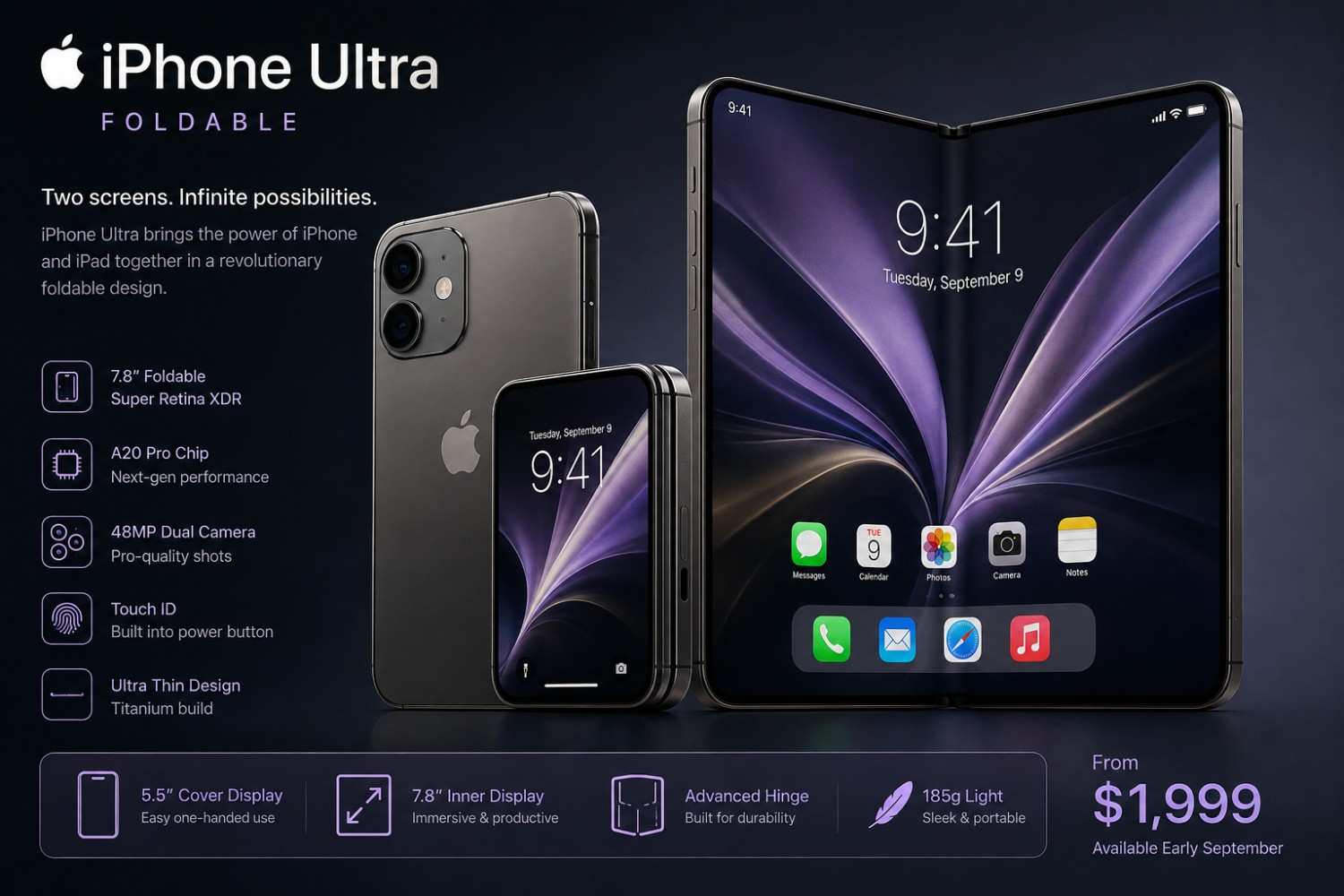
- Around 5.5-inch outer display
- Around 7.7–7.8-inch inner display
- Book-style folding mechanism
- Very thin profile when unfolded
- Minimal or nearly invisible display crease
- Titanium/aluminum construction
- Advanced hinge mechanism
- 4:3-style inner-screen aspect ratio
MacRumors currently lists a roughly 5.5-inch external display and approximately 7.8-inch internal screen among the expected specifications.
The big question isn’t simply screen size.
It is how well iOS adapts to the larger display.
That could be Apple’s biggest advantage—or its biggest weakness.
Why the 7.8-inch display could change how you use an iPhone
Foldables make sense when the larger screen actually changes your workflow.
For example, imagine opening the iPhone Ultra while traveling and having:
- Maps on one side
- Safari or email on the other
- A large keyboard for longer messages
- More comfortable video viewing
- A larger photo-editing workspace
- Multiple apps visible simultaneously
Reports suggest Apple is developing iPad-like application layouts specifically for the larger internal display. Fortune says people who have reportedly tested the device liked the larger-screen interface and hinge experience.
That is where I think Apple has an opportunity.
A foldable doesn’t need to replace your laptop. It simply needs to make those moments when your normal phone feels too small much less frustrating.
The hinge may be more important than the camera
Foldable phones live or die by their hinge.
A poor hinge can create wobble, increase the visible crease, allow dust intrusion or simply make a $2,000 phone feel fragile.
Apple reportedly has been working heavily on hinge durability and display-crease reduction. Earlier supply-chain reporting suggested hinge reliability was still an engineering concern, although later reports indicate the project remains on track for a September unveiling.
From my perspective, this is the specification I would watch most closely at launch.
A 48MP camera is easy to understand from a marketing slide.
A hinge that still feels solid after several years of daily folding is much harder to demonstrate.
What about the cameras?
Here is where the rumored iPhone Ultra gets surprisingly interesting.
Despite its expected price, reports indicate that Apple may use two rear cameras rather than a triple-camera system.
The cameras are widely rumored to include dual 48MP sensors, while a dedicated telephoto lens may be missing.
That sounds strange for a phone potentially costing more than $2,000.
But there is a practical reason.
Foldable phones have severe internal-space constraints. Engineers need room for two displays, the hinge, batteries, cameras, antennas and other components.
Adding a large telephoto camera module can make the device thicker and heavier.
So Apple may prioritize the overall foldable design rather than trying to match the camera hardware of an iPhone Pro Max.
Touch ID instead of Face ID?
This could be one of the biggest surprises.
Several reports claim the foldable iPhone may use Touch ID integrated into the power button instead of Face ID.
Why?
The internal architecture of a foldable is considerably more complicated.
Apple could be avoiding the additional space and component requirements associated with a traditional Face ID system.
For existing iPhone users, however, this could feel like a step backward.
I’ve become accustomed to picking up an iPhone and having Face ID work almost instantly. Going back to a fingerprint sensor would be a noticeable change.
What processor will power the iPhone Ultra?
The foldable is expected to use Apple’s next-generation A20-series chip, although exact specifications remain unconfirmed.
Some reports also point toward 12GB of RAM, which would make sense given the larger display and potentially more demanding multitasking capabilities.
The interesting part isn’t simply raw performance.
The extra memory could help Apple support more sophisticated multitasking, AI features and larger on-device workloads.
For a foldable, software optimization matters just as much as silicon performance.
How much will the iPhone Ultra cost?
This is where things get painful.
Current estimates generally put the foldable iPhone somewhere around $2,000–$2,500, with some analysts expecting a starting price around $2,300 or higher.
Some reports have suggested:
| Storage | Rumored Price |
|---|---|
| 256GB | ~$2,300 |
| 512GB | ~$2,600 |
| 1TB | ~$2,900 |
These figures are rumors, not Apple’s confirmed pricing.
And Indian pricing could be substantially higher after taxes, duties, currency conversion and Apple’s regional pricing strategy.
For Indian buyers, a $2,000 device isn’t simply a ₹ conversion exercise.
The final retail price in India could make this a luxury product rather than a mainstream iPhone.
A quick real-world scenario: who would actually need this?
Imagine someone who travels frequently for work.
They normally carry an iPhone plus an iPad because the phone is convenient for communication, but the larger display is better for documents, spreadsheets and presentations.
A foldable iPhone could potentially eliminate some of that duplication.
During a flight, the device stays closed for calls and messaging. Once seated, it opens into a much larger workspace.
That’s the value proposition I would personally focus on.
Not “Look, the phone folds.”
Instead:
“One device can handle more of the work you previously needed two devices for.”
That is a much stronger argument for spending $2,000.
What are the biggest advantages?
1. A much larger display
The rumored 7.8-inch internal screen could make reading, browsing and multitasking significantly more comfortable.
2. A premium hinge
If Apple’s engineering delivers the durability being reported, the hinge could become one of the phone’s biggest selling points.
3. iOS optimization
Apple controls both the hardware and software, giving it an opportunity to optimize iOS specifically for the foldable form factor.
4. Extremely thin design
Reports suggest Apple is targeting a very thin unfolded profile, potentially around 4.5mm.
5. A new category for Apple
This isn’t simply another yearly iPhone upgrade.
It represents Apple’s first major smartphone form-factor change in years.
But there are some serious compromises
A $2,000+ phone should be almost perfect.
The rumored iPhone Ultra doesn’t appear to be there yet.
Potential disadvantages include:
- No dedicated telephoto camera
- Touch ID instead of Face ID
- Extremely high price
- Possible limited launch availability
- Potentially higher repair costs
- More complicated display hardware
- Foldable-screen durability concerns
- Possibly delayed availability after the September announcement
Fortune specifically reports the lack of a telephoto camera and Face ID as two notable compromises.
That makes the pricing question even more important.
Will Apple actually call it the iPhone Ultra?
Possibly—but this remains unconfirmed.
Apple has not announced the name.
“iPhone Ultra” has become the dominant label in recent reports because it fits Apple’s existing premium branding strategy. MacRumors also says the name is rumored rather than confirmed.
Apple could still choose another name such as iPhone Fold or something completely unexpected.
Until Apple puts the name on the stage, treat “iPhone Ultra” as a rumor.
When can you buy the iPhone Ultra?
This is where the September headline needs some clarification.
The phone may be announced in September but released later.
Ming-Chi Kuo has compared Apple’s rumored strategy with the 2017 iPhone X, which was unveiled alongside other iPhones but became available for pre-order weeks later.
So there are potentially two dates to watch:
September 2026: expected announcement.
Q4 2026: possible pre-orders and retail availability.
That distinction could be particularly important because supply is reportedly expected to be limited during the initial production ramp.
FAQ: What people are asking about Apple’s foldable iPhone
Is Apple launching a foldable iPhone in September 2026?
Current reports strongly point toward a September 2026 unveiling, potentially alongside the iPhone 18 Pro and iPhone 18 Pro Max. Apple has not officially confirmed the product or date.
How much will the iPhone Ultra cost?
Reports generally estimate a starting price of around $2,000–$2,500, with some analysts expecting prices around $2,300 or higher.
Will the iPhone Ultra have Face ID?
Current rumors suggest no. Apple may reportedly use Touch ID integrated into the power button instead.
What screen size will the foldable iPhone have?
Rumors point toward an approximately 5.5-inch external display and 7.7–7.8-inch internal display.
Will the iPhone Ultra replace the iPhone Pro Max?
Probably not.
The foldable is expected to sit above Apple’s conventional Pro models as a premium product rather than replace the standard flagship design.
Final Verdict: Should you be excited?
Yes—but don’t preorder it based on rumors alone.
Apple’s first foldable iPhone could be one of the company’s most significant product launches in years. The combination of a large internal display, thin hardware, a redesigned hinge and foldable-optimized iOS could finally make the format feel less like a gimmick and more like a genuine productivity device.
But the price changes the conversation.
At $2,000 or more, I would want Apple to prove three things before recommending it:
- The hinge can survive years of daily use.
- The inner display is genuinely durable.
- iOS provides meaningful advantages on the larger screen.
If Apple nails those three areas, the iPhone Ultra could establish a new premium category.
If it doesn’t, buyers may simply be paying thousands of dollars to become Apple’s beta testers.
For now, I’d wait for the September event and pay particular attention to real-world hinge demonstrations, camera compromises, battery life, repairability and the final Indian price.
The foldable iPhone is no longer just a distant rumor. The question now is whether Apple’s first attempt will justify the Ultra-sized price tag.
Note: Apple has not officially confirmed the iPhone Ultra, its specifications, price or launch date at the time of writing. The details above are based on current reports and analyst/supply-chain information and may change before Apple’s official announcement.
- 300 Paid Tools vs 300 Free Alternatives: Stop Paying for Software in 2026 by techbhavik

- Apple to launch $2,000-plus foldable ‘iphone Ultra’in early September

- ASUS v16 laptop deal: Save on RTX 5070 at Amazon


Bhavik Munjapara is a technology writer and the founder of TechBhavik.com. Since 2023, he has covered AI tools, smartphones, software, and consumer technology, focusing on practical guides, unbiased research, and real-world insights that help readers stay informed in a fast-changing digital world.
Contact: contact@techbhavik.com
Contact: X (Twitter)