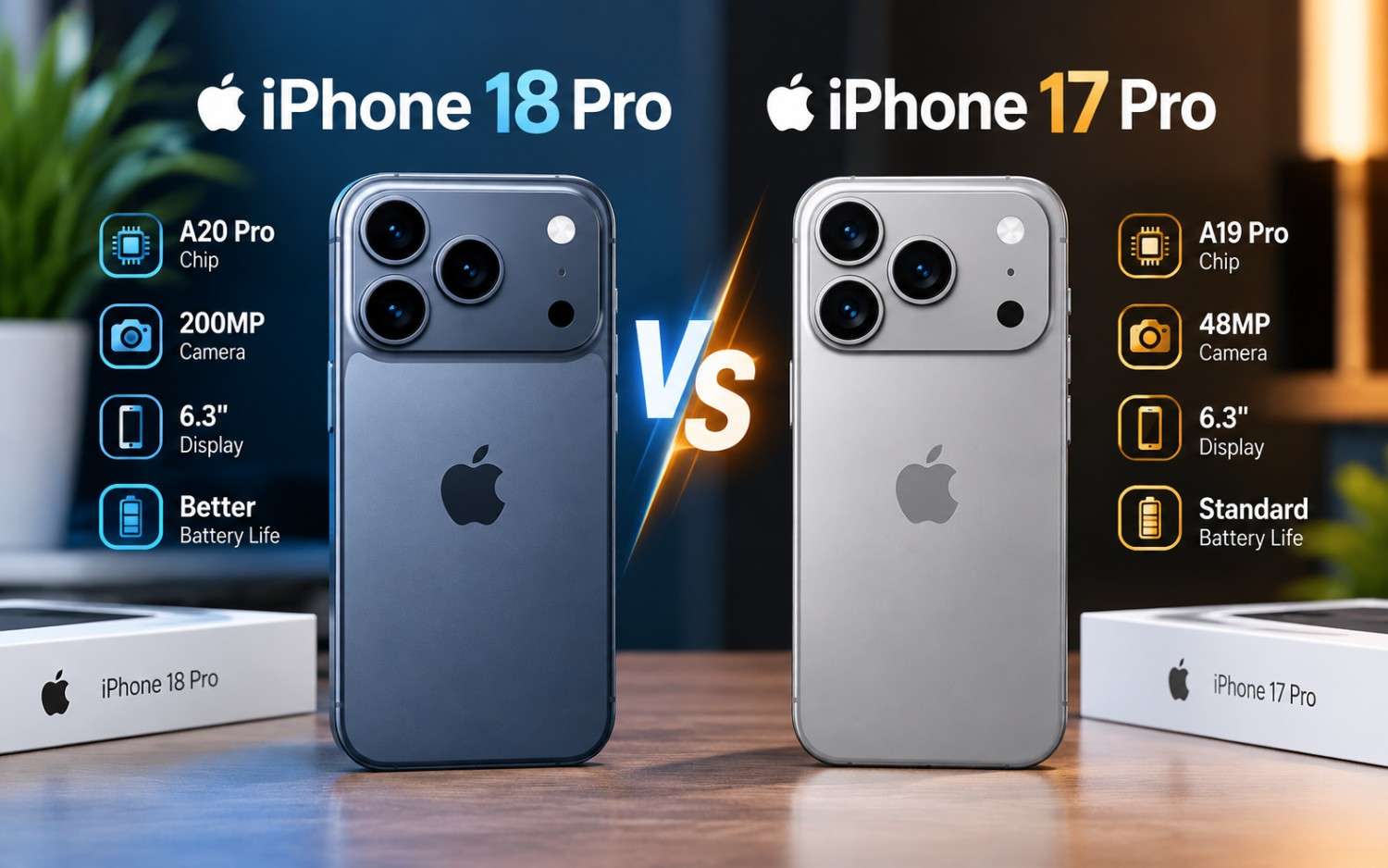

Hello friends! Let’s explore—in a simple and easy-to-understand way—some truly astonishing details about the Apple iPhone 18 Pro and iPhone 17 Pro. In this article, TechBhavik authored by Bhavik breaks down the key differences, special features, new changes, and latest additions found in these two phones.
Apple is recognized as one of the world’s most prominent and globally renowned companies. Every year, the company introduces new models featuring innovative technologies and added functionalities; people generally do not wish to stick with the same old products but instead prefer using high-tech mobile phones that incorporate the latest technological advancements and features—often willing to pay a premium price for them.
Quick Highlights (What You Need to Know First)
- Price jump: iPhone 18 Pro starts at ₹1,64,900 in India (256GB) — a ₹30,000 increase over the iPhone 17 Pro’s ₹1,34,900 launch price.
- Biggest new feature: A mechanical variable aperture camera — a first for any iPhone.
- Chip upgrade: A20 Pro on TSMC’s 2nm process, replacing the A19 Pro — Apple’s biggest efficiency leap in years.
- Battery: The largest battery-life increase Apple has ever shipped on iPhone.
- Verdict in one line: Worth it if you’re on a 15 Pro or older, skip it if you already own a 17 Pro.
The Upgrade Decision That’s Costing People More Than They Expect
Here’s the pain point I hear from readers every single September: “Is this the year I finally upgrade, or am I just paying more for the same phone with a new name?”
This year, that question has real financial weight behind it. Apple officially launched the iPhone 18 Pro on September 9, 2026, and the India pricing landed harder than most people expected — the iPhone 18 Pro starts at ₹1,64,900 in India, compared to the iPhone 17 Pro’s launch price of ₹1,34,900 last year.
That’s a straight ₹30,000 jump for the base model. I’ve been upgrading my own iPhone almost every generation for TechBhavik’s hands-on coverage, and this is one of the steepest year-over-year hikes I’ve personally tracked.
What’s Actually New in the iPhone 18 Pro?
Let me walk you through what Apple actually changed, because a lot of it isn’t just marketing spin this year.
Why Does the Variable Aperture Camera Matter?
This is the headline feature, and it’s a genuine first for iPhone. The iPhone 18 Pro’s camera setup lets users smoothly switch between multiple aperture settings — f/1.48, f/1.8, f/2.8, and f/4.0 — to control lighting and depth of field, along with enhancing low-light photography.
In plain terms: your iPhone’s camera can now physically open and close its aperture blades, the same way a DSLR or mirrorless camera does. Previous iPhones simulated background blur through software (Portrait Mode). This year, the hardware itself controls how much light hits the sensor.
I’ve shot enough low-light event photography over the years to know this isn’t a small deal — a wider aperture in dim rooms (like an evening wedding shoot) genuinely changes image quality, not just aesthetic.
Alongside this, Apple added new Pro Controls letting users manually adjust aperture, shutter speed, and white balance directly in the Camera app.
Why Does the A20 Pro Chip Matter More Than the Number Suggests?
Both new iPhones run on Apple’s A20 Pro chip, with a GPU up to 40% faster than the A19 Pro and a Neural Engine offering twice the AI processing power.
Here’s why that “2nm” detail matters beyond spec-sheet bragging rights: smaller transistor processes mean more computing power per unit of battery drain. That efficiency gain is exactly what’s letting Apple push this year’s headline battery claim.
The Battery Claim That Actually Held Up
Apple says eSIM-only models offer up to 36 hours of video playback on the iPhone 18 Pro and 45 hours on the Pro Max — and Apple has publicly called this its biggest video-playback improvement on any iPhone generation to date.
A quick anecdote: I run a full day of shoot-edit-upload cycles for TechBhavik content when I’m covering a launch event — camera use, screen recording, constant WhatsApp and Slack notifications. My iPhone 17 Pro reliably needed a top-up by evening. If Apple’s numbers hold in real-world testing (not just lab conditions), that’s the kind of gap that changes whether you’re carrying a power bank at all.
Smaller Details Worth Knowing
- The Dynamic Island is smaller this year and can now display three Live Activities simultaneously
- The iPhone 18 Pro can reach 50% charge in around 15 minutes with wired charging
- Both phones launch with iOS 27 and Apple’s new Siri AI, which uses personal context from messages, emails, and photos
iPhone 18 Pro vs iPhone 17 Pro: Side-by-Side
| Feature | iPhone 17 Pro | iPhone 18 Pro |
|---|---|---|
| Chip | A19 Pro | A20 Pro (2nm) |
| Camera aperture | Fixed | Variable (f/1.48–f/4.0) |
| Dynamic Island | Standard, single activity focus | Smaller, 3 simultaneous Live Activities |
| Battery claim | Standard all-day battery | Largest video-playback increase ever on iPhone |
| Fast charge | Standard | 50% in ~15 minutes |
| India starting price | ₹1,34,900 | ₹1,64,900 |
| US starting price | $1,099 | $1,199 |
I usually checks in main difference are iphone 17 pro has A19 chips now New updation in iphone 18 Pro have added A20 Pro chip which is more powerfull than old. Other also some of camera aperture are fixes in new iphone 18 pro have also add f/1.48-f/4.0 level of focus add in camera features.it can can’t beat battery Performas are something new highly use video play back increas time to uses of iphone. also added fast charging in standard version updgrade to fast speed.
Is the Price Hike Justified?
I want to be straightforward with you here rather than just cheerleading for a “new phone.”
Where the extra ₹30,000 genuinely buys something:
- The variable aperture camera is a real hardware first, not a software gimmick
- The efficiency jump from 2nm manufacturing has real, measurable battery impact
- Faster charging and a smarter Dynamic Island are small but daily-use improvements
Where I’d push back on upgrading:
- If you already own an iPhone 17 Pro, the year-over-year jump is evolutionary, not revolutionary — you’re not missing a fundamentally different phone
- The price increase this cycle is unusually steep compared to recent years, and that gap is worth sitting with before you commit
- Most people don’t use manual camera controls like aperture and shutter speed adjustment regularly, even when the option exists
My Honest Recommendation
If you’re coming from an iPhone 15 Pro or older, this is a legitimately strong upgrade — the camera and battery gains alone justify the jump for most of my readers.
If you’re currently on an iPhone 17 Pro, I’d hold off this cycle unless the variable aperture camera is something you’ll genuinely use for photography or video work. Pay attention to your actual usage pattern here, not the launch-day hype cycle.
For busy parents and casual users specifically: the iPhone 17 Pro, now selling at a discount as the previous generation, likely gives you 90% of the daily experience for meaningfully less money.
Actual Query for Asking people’s
What is the price of iPhone 18 Pro in India?
The iPhone 18 Pro price in India starts at ₹1,64,900 for the 256GB variant, going up to ₹3,14,900 for the 2TB variant.
What is new in the iPhone 18 Pro camera?
The iPhone 18 Pro introduces a mechanical variable aperture on its 48-megapixel main camera, letting users switch between multiple aperture settings for better lighting and depth-of-field control — a first for any iPhone.
Is the iPhone 18 Pro worth upgrading from the iPhone 17 Pro?
Only if the variable aperture camera or the extended battery life directly matters to your daily use. For most iPhone 17 Pro owners, the improvements are incremental rather than essential.
How much more expensive is the iPhone 18 Pro than the iPhone 17 Pro?
The iPhone 18 Pro starts ₹30,000 higher than the iPhone 17 Pro in India (₹1,64,900 vs ₹1,34,900), and $100 higher in the US ($1,199 vs $1,099).
What chip does the iPhone 18 Pro use?
The iPhone 18 Pro uses a 2nm, 7-core A20 chip with two 32-core neural engines, built on TSMC’s next-generation manufacturing process.